GDP Growth Remains Subpar Despite Q1 2026 Expansion
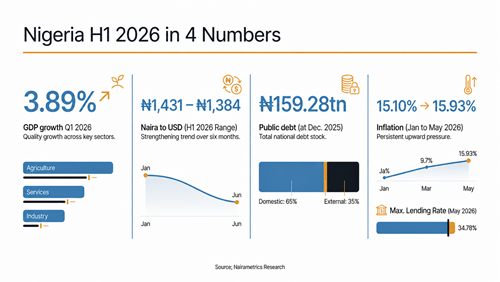
Nigeria's economy recorded a Gross Domestic Product (GDP) expansion of 3.89% in the first quarter of 2026, according to the National Bureau of Statistics. This marks an improvement from the 3.13% recorded in the same quarter a year earlier and is marginally above the 3.87% growth posted for full-year 2025.
Despite this growth, economists generally agree that Nigeria's rapidly expanding population and labour force require consistent GDP growth exceeding 5% to generate sufficient jobs and reduce poverty meaningfully. The current pace is not enough to transform living standards across the country.
The benefits of Nigeria’s economic reforms remain unevenly distributed. Consumers continue to bear the burden of higher living costs, while the government enjoys stronger tax collections, investors benefit from elevated yields on government securities, and exporters gain from a more competitive exchange rate.
A closer look at the Q1 2026 GDP numbers reveals that services once again drove the economy. Telecommunications expanded by 12.24%, financial services grew by 8.54%, and cement manufacturing rose by 11.53%. These sectors generate significant revenues but do not employ enough Nigerians to fundamentally alter the country’s employment profile.
In contrast, agriculture, Nigeria’s largest employer, grew by just 3.15%. Manufacturing expanded by only 3.29%, while the oil and gas sector, which finances much of government spending and foreign exchange earnings, recorded growth of just 2.57%. Crop production, trade, real estate, telecommunications, construction, and livestock collectively account for approximately 65% of nominal GDP, yet most of these sectors, excluding telecommunications, continue to record low single-digit growth rates.
The International Monetary Fund (IMF) became more cautious in its April 2026 World Economic Outlook, revising Nigeria’s 2026 growth forecast down by 0.3 percentage points to 4.1%. Achieving this target will require significant acceleration in the second half of the year, particularly in sectors like agriculture, manufacturing, construction, trade, and energy, which employ the majority of Nigerians.
Naira Stability in H1 2026 Driven by Remittances and Dangote Output
The first half of 2026 was characterized by a notable stability in Nigeria's exchange rate, a stark contrast to the volatility experienced in 2023 and 2024. The Naira, which opened at N1,431 to the dollar in the NFEM window in January 2026, appreciated to N1,384 by June, marking an N47 gain across 118 trading days.
The average exchange rate for the period stood at N1,375.93. This steadiness proved crucial for businesses pricing imports, manufacturers planning production, and households budgeting for expenses, providing a level of predictability previously absent.
Three primary factors contributed to this stability: consistent diaspora remittance inflows, the Central Bank of Nigeria’s (CBN) managed float policy, and the increasing petrol output from Dangote Refinery. The refinery's production began to reduce Nigeria’s dependence on refined product imports, a major structural source of dollar demand.
A calmer Naira translated into fewer foreign exchange losses for companies, directly boosting profitability. While the parallel market gap narrowed, it did not entirely close, but the overall direction was positive. The trajectory for H2 depends on the persistence of these variables, as remittance flows are seasonal, CBN intervention capacity relies on reserves, and Dangote’s import substitution effect is tied to both refinery output and global product prices.
Government Borrowing Surges, Crowding Out Private Sector Credit
Federal Government borrowing emerged as a critical factor shaping H1 2026 and is set to continue influencing the second half of the year. Nigeria’s total debt stock, as reported by the Debt Management Office, stood at N159.28 trillion as of December 2025, comprising N74.43 trillion in external obligations and N84.85 trillion in domestic debt.
By May 2026, credit to the Federal Government had dramatically increased to N40.38 trillion, representing a 75.6% jump from N22.99 trillion in May 2025. This figure further rose by N779.7 billion in a single month, indicating aggressive government borrowing.
This surge in government paper made it irresistible for banks due to its risk-free, high-yielding, and abundant nature. Consequently, credit to the private sector grew only modestly to N81.04 trillion, as manufacturers, farmers, and small businesses were crowded out, often resorting to commercial paper at even higher yields.
The financial system appeared healthy on the surface, with profitable banks and attractive yields, but the real economy remained starved of the affordable credit necessary for growth and expansion.
Inflation Rises, High Lending Rates Squeeze Consumers and Businesses
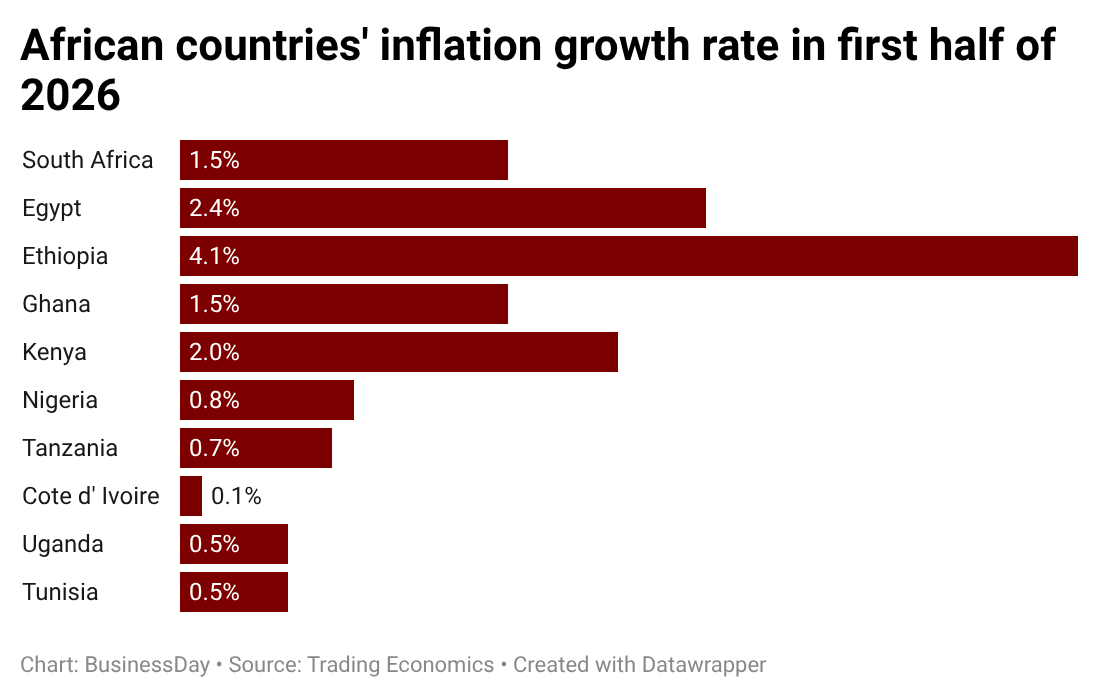
Inflation, another key variable, moved in the wrong direction during H1 2026, rising from 15.10% in January to 15.93% by May. More concerning was the food inflation rate, which nearly doubled from 8.89% in January to 16.96% by May, significantly impacting households where food constitutes the largest share of monthly spending.
The Central Bank of Nigeria (CBN) implemented only one benchmark rate cut during H1, reducing it from 27.00% in January to 26.50% in February, and then holding it steady. This cautious approach had immediate consequences, with maximum lending rates reaching 35.17%, making productive borrowing almost impossible for most businesses.
Furthermore, savings deposit rates were a mere 7.24% against an inflation rate of 15.93%, meaning Nigerians holding money in banks were consistently losing purchasing power. The combined effect was a dual squeeze on the economy: businesses could not afford to borrow and expand, while households lacked the purchasing power to stimulate consumer demand.
Private investment remained suppressed, directly limiting the GDP acceleration needed in H2. The outlook for the second half hinges on whether food inflation reverses during the harvest season and if the CBN gains enough confidence to implement further rate cuts. If these conditions materialize, borrowing costs may ease and consumer pressure could soften; otherwise, the squeeze is likely to persist into 2027.
Uncertainty Looms for H2 2026 with Election Cycle and Fiscal Weakness
The confluence of these economic variables paints a picture of an economy with real but narrow growth, a stable yet fragile Naira, a large and climbing public debt, and inflation that has moderated at the headline level but continues to accelerate in critical areas like food prices and borrowing costs. This complex scenario sets the stage for an uncertain second half of 2026.
Adding another layer of uncertainty, the second half of 2026 will coincide with the early stages of Nigeria’s 2027 election cycle. Historically, election seasons tend to divert policymakers' attention from economic reforms towards political considerations and campaign activities, often slowing the pace of policy implementation and delaying difficult fiscal decisions.
Fiscal execution also remains a significant concern. Budget implementation has been weak over the past three years, hindering the government’s ability to translate ambitious spending plans into tangible economic activity. While official implementation data for the 2026 budget is pending, the recent extension of the 2025 budget suggests that execution remains behind schedule, raising questions about the pace of government spending and its impact on the economy.