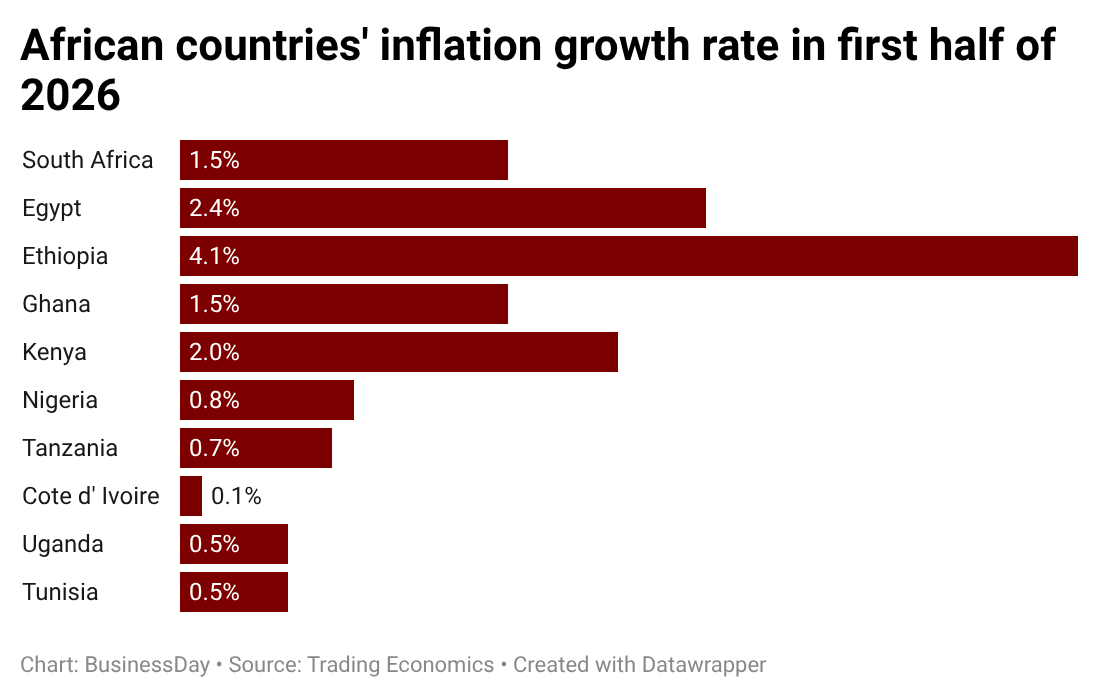
Inflation across the African continent remained elevated in June 2026, with figures compiled from the latest consumer price index (CPI) reports from national statistical agencies and central banks. The data reflects recent available readings spanning between May and June 2026, excluding South Sudan due to outdated data (May 2025) and Libya due to ongoing methodological inconsistencies in its inflation estimates.
Sao Tome and Principe recorded an inflation rate of 9.2% in May 2026, an increase of 0.6 percentage points from 8.6% in the previous month. This island nation remained the only country on the list with inflation below 10%, with price pressures declining after a relatively stable period, influenced by global food and energy prices due to its import-dependent economy.
Angola’s inflation rate eased to 10.11% in June 2026 from 10.88% in May, marking a decline of 0.77 percentage points. This extended the country’s disinflation trend for the 23rd consecutive month, following a peak above 31.09% in July 2024, supported by tighter monetary policy and kwanza stability, though still above the central bank’s single-digit target.
Botswana recorded an inflation rate of 10.7% in June 2026, unchanged from the previous month. This flat reading suggests a stall in food and transport costs, with underlying price pressures remaining sticky, despite Botswana maintaining one of Southern Africa’s more stable macroeconomic environments.
Egypt’s annual inflation rate declined to 12.2% in June 2026 from 13.0% in May, a drop of 0.8 percentage points. This moderation reflects the fading impact of earlier currency devaluations and aggressive monetary tightening by the Central Bank of Egypt over the past two years, though inflation remains elevated by Egyptian standards.
Sierra Leone posted one of the sharpest increases, with prices rising to 12.69% in May 2026 from 10.83% previously, an increase of 1.86 percentage points. This surge was driven by higher food prices, which rose to 5.17% from 3.56%, and non-food inflation climbing to 18.63% from 16.62%. Housing and utility costs surged 65.46% year-on-year, while transport inflation accelerated to 37.4%.
Ethiopia’s inflation rate rose to 13.4% in May 2026 from 11.7% in April, an increase of 1.7 percentage points. Food inflation rose for the third consecutive month, with the renewed acceleration keeping Ethiopia among the continent’s highest inflation economies after briefly returning to single-digit inflation at 9.4% in March.
Rwanda recorded an inflation rate of 13.6% in June 2026, up from 12.9% in the previous month. The 0.7 percentage point increase marked one of the larger monthly accelerations among the countries reviewed, suggesting consumer prices remain sensitive to imported inflation despite strong macroeconomic monitoring.
Nigeria recorded an inflation rate of 15.91% in June 2026, marginally lower than the 15.93% recorded in May. This 0.02 percentage point decline extended the country’s disinflation streak, though the pace of improvement remained extremely modest. Food prices continue to account for the largest share of inflationary pressure, while exchange rate stability and easing energy prices provided some support. S&P Global recently raised Nigeria’s average inflation forecast for 2026 to 16.9%.
Burundi’s inflation rate slowed to 18.4% in June 2026 from 20.8% previously, representing a decline of 2.4 percentage points. The country recorded the second-largest decline among the ten economies reviewed, though inflation remained among the highest on the continent due to persistent supply shortages and dependence on imported consumer goods.
Malawi recorded Africa’s highest inflation rate in June 2026 at 21.1%, despite posting the largest decline among the countries reviewed. The country’s inflation rate fell from 23.4% in May, a 2.3 percentage point decline, largely driven by easing food prices, which slowed to 14.7% in June from 17.6% in the previous month. Even with this improvement, inflation remains above 20%, reflecting continued pressure from food prices, foreign exchange shortages, and elevated import costs.
Overall, inflation is easing across much of the continent, with five of the ten countries reviewed recording lower inflation rates compared to the previous reporting period. This suggests that tighter monetary policy and improving supply conditions are beginning to yield results. Food inflation remains the dominant driver of headline inflation across most African economies, with countries highly dependent on food imports or with weaker agricultural output facing stronger price pressures. Exchange rate stability is also increasingly important, with economies that have managed to stabilize their currencies generally seeing faster declines in consumer prices.