Nigerian factories are at a significant competitive disadvantage due to high production costs, according to Kamar Bakrin, Executive Secretary of the National Sugar Development Council (NSDC). He revealed that manufacturers in Nigeria pay between two and 10 times more for essential inputs like electricity, credit, and logistics compared to businesses in countries such as Vietnam and China.
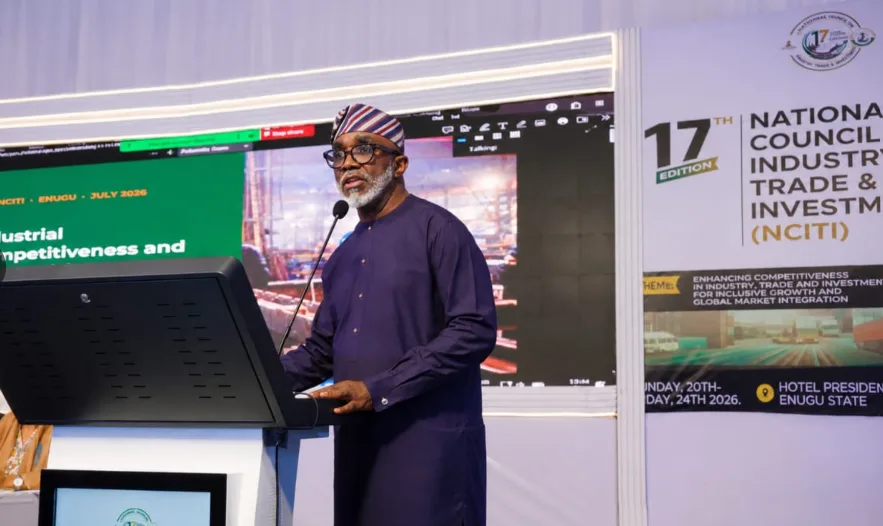
Bakrin presented these findings at the technical session of the 17th National Council on Industry, Trade and Investment in Enugu. He emphasized that the primary challenge for Nigerian manufacturers is the high cost of production, not a lack of demand for their products.
Industrial electricity costs in Nigeria are notably higher, averaging about 15 cents per kilowatt-hour on the national grid and rising to nearly 30 cents when relying on diesel generators. This contrasts sharply with Vietnam’s 8 cents and China’s 10 cents per kilowatt-hour. Bakrin noted that Nigerian manufacturers collectively spent an estimated N1.34tn generating their own electricity last year, effectively running a "second, unwanted business as a private power station."
The cost of working capital also presents a major hurdle, standing at 27% to 35% in Nigeria, compared to approximately 9% in Vietnam and 3% in China. Furthermore, Nigeria's logistics performance is poor, ranking 88th out of 139 countries on the World Bank’s Logistics Performance Index, significantly behind Vietnam (43rd) and China (19th).
These factors contribute to manufacturing's modest contribution of barely 8% to Nigeria's Gross Domestic Product (GDP), with capacity utilisation slipping to 57.7%. Bakrin highlighted that despite Nigeria having 230 million consumers and duty-free access to 1.4 billion more under the African Continental Free Trade Area (AfCFTA), the country struggles to compete.
Bakrin acknowledged that the government's macroeconomic reforms have brought stability, with inflation roughly halved from its peak and reserves reaching $51bn, the highest since 2009. He stressed that this period offers a crucial window for factories to plan and invest, especially as global supply chains are being redrawn.
He cited Nigeria’s urea industry as a success story, demonstrating how competitive pricing of industrial inputs can drive growth. Urea production capacity surged from 500,000 tonnes in 2005 to 6.5 million tonnes, positioning Nigeria among the top 10 global exporters of nitrogen fertiliser, after natural gas was priced as an industrial input rather than solely a revenue source.
To enhance industrial competitiveness, Bakrin outlined four key targets: power delivered to industrial clusters at 8–10 cents per kilowatt-hour around the clock; industrial lending in single digits at meaningful volume; port clearance in under seven days, down from 18–21 days; and output per worker doubled by 2030.
He also proposed four resolutions for the Council’s adoption: every state should designate at least one industrial cluster for a dedicated power arrangement within 12 months; a federal-state compact should harmonise levies and clear informal checkpoints on industrial corridors; an annual State Industrial Competitiveness Index should rank every state publicly on power, land, levies and logistics; and Nigeria First procurement should be enforced at federal and state levels with quarterly compliance dashboards.
Bakrin emphasized that public support, including tax credits and subsidised power, must be earned continuously and transparently, conditional on verified and published performance. He urged state governments to leverage the Electricity Act 2023 to develop competitive power markets, improve access to industrial land, streamline levies, and align technical education with industrial needs.
Improving industrial competitiveness is expected to create jobs for millions of young Nigerians, strengthen the naira through increased exports and import substitution, and reduce emigration. Bakrin concluded, "The reform half of Nigeria’s story has been written. The industrial half will be written in kilowatt-hours, lending rates and port days. The window is open. No window stays open forever."