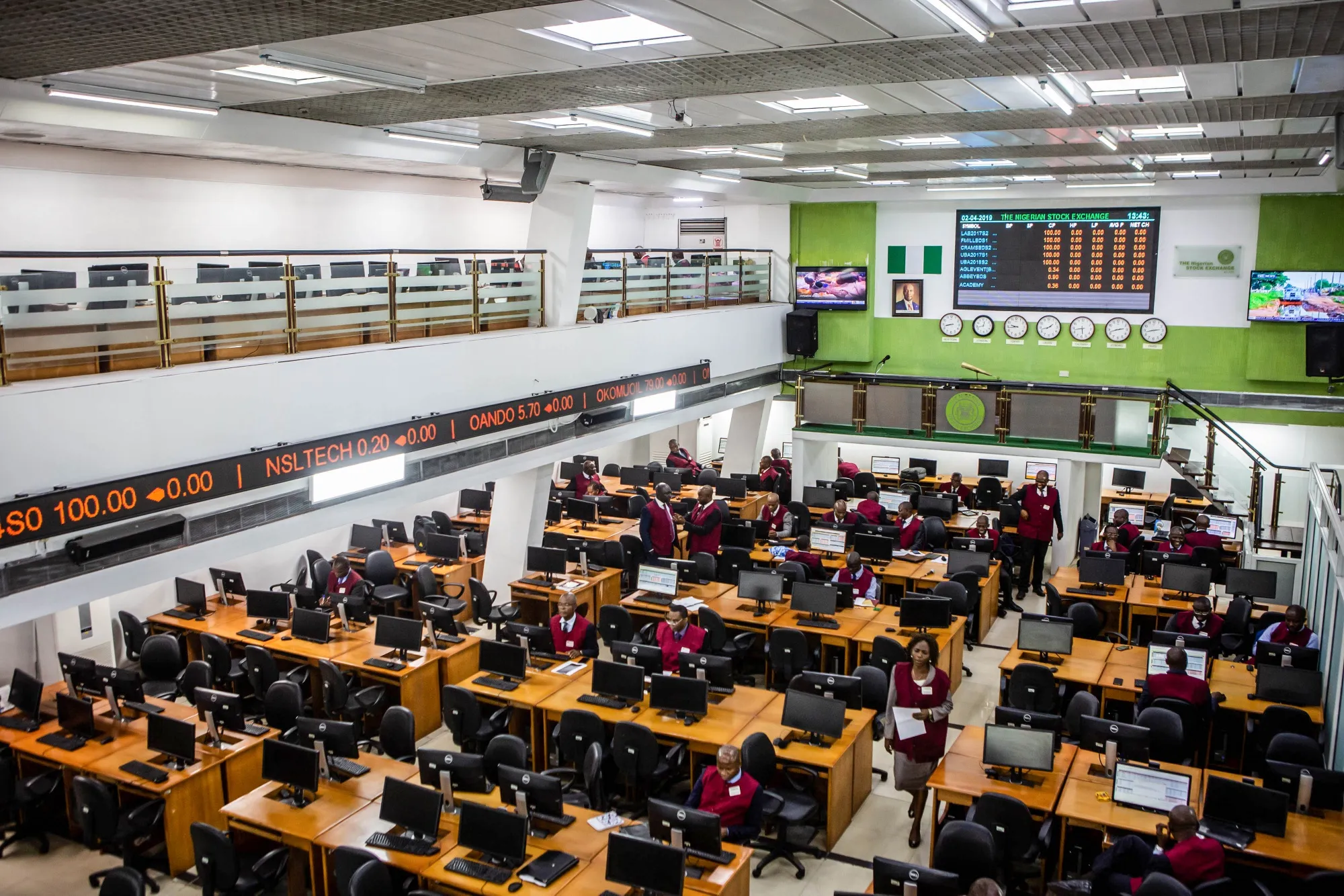
Nigeria's largest listed companies, classified as Stocks Worth Over One Trillion Naira (SWOOT), recorded a sharp decline in market capitalization during June 2026. Data from the Nigerian Exchange indicates their combined value fell by N11.97 trillion month-on-month.
The total market capitalization for 25 SWOOT companies dropped from N145.74 trillion in May 2026 to N133.78 trillion in June 2026. This represents an 8.21% loss in value within a single month.
This decline reflects a broad-based correction across the exchange’s most capitalized stocks, driven by aggressive profit-taking after months of strong gains. Persistent foreign exchange volatility, elevated interest rates, portfolio rebalancing, and regulatory developments in specific sectors also contributed to the pullback.
SWOOT stocks account for a significant portion of the NGX’s total market capitalization. A decline in share prices directly reduces a company’s market value, even when the number of outstanding shares remains unchanged.
The N11.97 trillion decline wiped out a substantial portion of the gains recorded by large-cap stocks earlier in the year. Several of the biggest listed companies recorded notable valuation and double-digit percentage losses, particularly in telecoms, cement manufacturing, consumer goods, and financial institutions. Airtel Africa was the only heavyweight stock to record a substantial gain of N4.28 trillion, while Nestlé Nigeria, Presco, Transcorp Hotels, and Transcorp Power Plc maintained their valuations.
Dangote Cement Plc recorded the largest decline among the tracked companies, losing N3.66 trillion in market capitalization. Its valuation fell from N19.91 trillion in May to N16.25 trillion in June, an 18.39% decline. With approximately 16.87 billion shares outstanding, this indicates a significant reduction in share price value, affected by profit-taking and broader concerns over construction demand, energy costs, and elevated borrowing costs.
BUA Cement Plc lost N2.70 trillion in value, with its market capitalization dropping from N14.22 trillion to N11.52 trillion, a 19.0% decline. Based on its roughly 33.86 billion shares outstanding, this reflects a substantial reduction in investor valuation, driven by profit-taking and growing interest in higher-yielding fixed-income securities.
In the energy sector, Aradel Holdings Plc posted one of the steepest percentage declines. Its market capitalization fell from N8.40 trillion to N6.16 trillion, a loss of N2.24 trillion and a 26.7% contraction. This correction followed a period of significant appreciation, with investors realizing profits amid fluctuations in crude oil prices and broader energy market uncertainty. Aradel has approximately 4.34 billion shares outstanding.
MTN Nigeria saw its valuation decline from N17.22 trillion in May to N15.12 trillion in June, representing a loss of N2.10 trillion or 12.2%. With approximately 20.99 billion shares outstanding, the decline implies a loss of roughly N100 per share. This pullback reflects profit-taking and investor caution amid persistent currency volatility, cost pressures, and a high-interest-rate environment.
The banking sector also witnessed substantial declines. Zenith Bank lost N870 billion in market capitalization, falling from N5.38 trillion to N4.52 trillion, a 16.09% drop. With approximately 31.4 billion shares outstanding, this reflects weaker investor sentiment due to regulatory adjustments and ongoing recapitalization efforts.
United Bank for Africa saw its market capitalization decline by N270 billion, from N1.97 trillion to N1.70 trillion, a 13.71% drop. Guaranty Trust Holding Company (GTCO) lost N440 billion in market value, falling from N5.01 trillion to N4.57 trillion, an 8.76% contraction. Fidelity Bank shed N180 billion, with its market capitalization declining from N1.34 trillion to N1.16 trillion. Wema Bank recorded one of the sharpest percentage declines among financial stocks, losing N300 billion in value as market capitalization dropped from N1.34 trillion to N1.04 trillion, a 22.39% decline. ETI lost N40 billion, with market capitalization slipping from N1.77 trillion to N1.73 trillion, while Stanbic IBTC’s valuation fell by N100 billion, declining from N2.69 trillion to N2.59 trillion.
Consumer goods companies also recorded contractions. BUA Foods lost N500 billion, while Nigerian Breweries shed N340 billion. International Breweries lost N360 billion, reflecting weaker investor appetite amid concerns about household spending power and inflationary pressures. Lafarge Africa’s market capitalization declined by N520 billion, and Okomu Oil Palm lost N320 billion. Geregu Power shed N540 billion, representing an 18.99% decline in market value, as investors locked in gains after its strong performance in previous periods.
Despite the N11.97 trillion loss recorded in June, the combined market capitalization of SWOOT companies remains significantly above the N86.43 trillion recorded in December 2025. This underscores the substantial gains these stocks have delivered over the past six months. While June’s decline appears to be more of a market reset than a sign of weakening fundamentals, their ability to recover lost ground will depend on the unfolding economic landscape, particularly regarding interest rates, currency stability, company earnings, and investor sentiment.