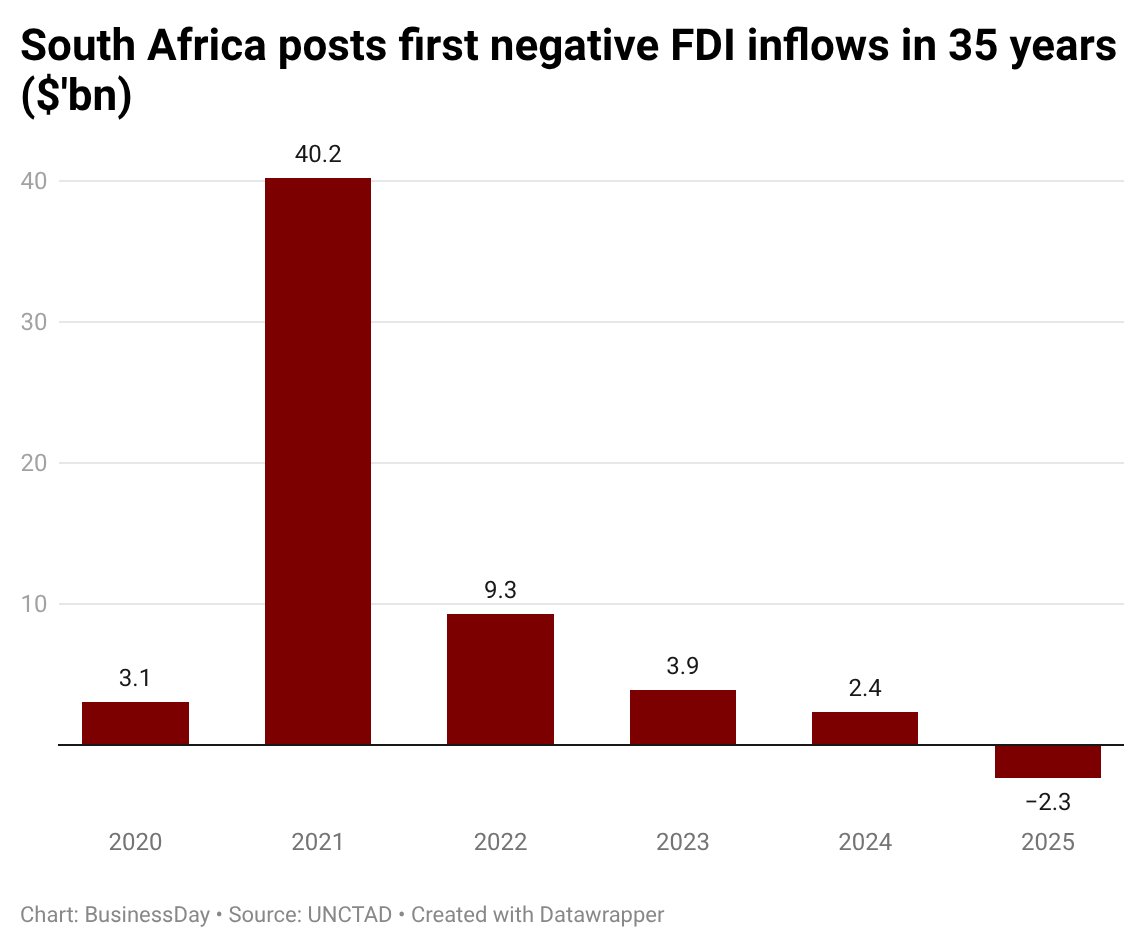
South Africa recorded negative Foreign Direct Investment (FDI) inflows last year for the first time since 1990, as multinational companies repatriated profits, adjusted intracompany financing, and completed major Mergers & Acquisitions (M&A) transactions. BusinessDay analysis of the World Investment Report 2026, released by the United Nations Conference on Trade and Development (UNCTAD), showed that Africa’s largest economy recorded FDI inflows of -$2.32 billion in 2025.
This figure contrasts with a positive value of $2.37 billion in 2024. The last time the country recorded a negative FDI position was in 1990, when inflows stood at -$78 million. A negative FDI figure does not necessarily mean foreign companies are exiting South Africa or that new investment has stopped, as FDI data captures the net movement of capital between foreign parent companies and their local affiliates.
Factors Driving Negative Flows
The country’s negative data was primarily driven by three main factors. First, profit repatriation rose as foreign-owned companies transferred earnings to parent firms abroad rather than retaining them for expansion in South Africa. When companies distribute profits instead of reinvesting them locally, reinvested earnings—a major component of FDI—decline.
Second, intracompany financial flows turned negative. These flows include loans, debt repayments, cash pooling, and other funding arrangements between multinational groups and their South African subsidiaries. Repayments by local affiliates to overseas parent companies can reduce net FDI, even where factories, offices, and productive assets remain in the country.
Third, large M&A and corporate restructuring transactions affected the direction of capital flows. UNCTAD cited the spinoff and listing of Valterra Platinum by Anglo American and the acquisition of MultiChoice by Canal+ as notable transactions during the year. Such deals can produce temporary swings in FDI data depending on how assets are financed, whether shareholders are paid abroad, and whether proceeds are transferred out of the country.
Africa's Broader Investment Landscape
Despite the negative inflow figure, South Africa remained an important destination for announced investments in manufacturing, energy, and services. UNCTAD noted that South Africa, alongside Algeria, Namibia, Ethiopia, and Nigeria, attracted large projects in hydrocarbons, refining, battery storage, and industrial production in 2025.
The country’s industrial base, relatively deep capital markets, established financial system, and position as a gateway to southern Africa continue to support its appeal for multinational companies, particularly in renewable energy, critical minerals, logistics, automotive manufacturing, and digital services. South Africa is also increasingly positioned in global investment themes linked to energy transition and supply-chain diversification.
The report also highlighted that Botswana posted net outflows of -$654 million in 2025, its first negative reading since 2021. This divergence across the continent reflects that annual FDI figures can be heavily influenced by a small number of large corporate transactions, debt movements, and profit distributions, rather than solely by new greenfield investment.
Africa’s total FDI inflows declined to $70 billion in 2025 from an exceptional $94 billion in 2024. The 2025 figure nevertheless remained historically strong, standing about one-third above the average recorded between 2010 and 2024. The 2024 total was lifted by a small number of unusually large transactions, particularly Egypt’s Ras El-Hekma construction and real estate megaproject.
Egypt remained Africa’s largest FDI destination despite a 66.7 percent decline in inflows to $15.5 billion. Guinea recorded the fastest growth, with inflows rising 457.1 percent to $7.76 billion, supported by bauxite and iron ore investments. Mozambique attracted $5.69 billion, largely linked to hydrocarbons and liquefied natural gas projects, while Nigeria ranked fourth after FDI inflows rose to $4.01 billion, driven mainly by oil and gas-related international project finance deals.
The report also indicated that African greenfield project values fell by almost one-third in 2025, although the number of projects increased. This suggests that investors continued to commit to a broader range of smaller projects despite geopolitical tensions, trade-policy uncertainty, and a more selective global investment environment. Africa’s least developed countries received about $33 billion in FDI in 2025.