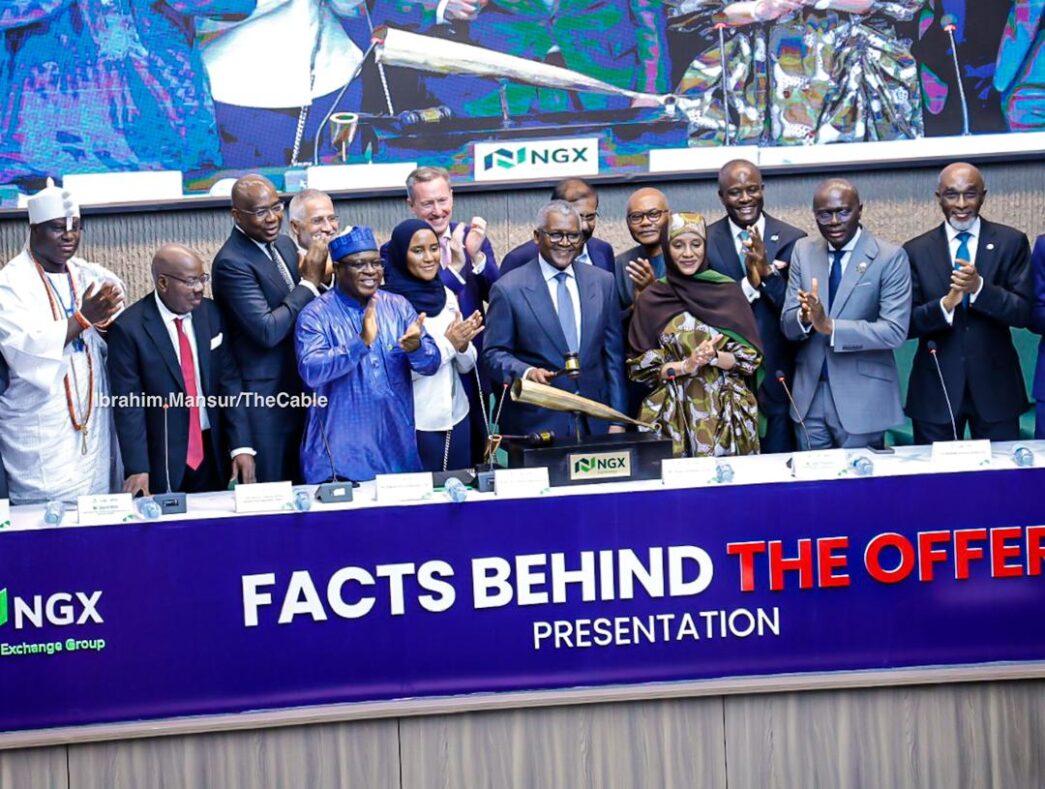
Since the Dangote Refinery IPO opened at ₦525 per share, a neat comparison has been circulating among Nigerian investors.
Seplat came to the market at ₦576 in 2014 and now trades at almost ₦15,000. Dangote Refinery is starting at ₦525.
The suggestion, sometimes stated directly and sometimes left hanging, is that long-term investors who get into Dangote today could be looking at another Seplat.
That comparison has enough truth to make it attractive. An investor who bought Seplat at its IPO and held through everything that followed has done very well. On September 14, 2026, Seplat closed at ₦14,907.80, giving it a market capitalization of about ₦8.94 trillion. Compared with its ₦576 IPO price, the share price has risen about 25.9 times, or 2,488%, before dividends.
But ₦576 in 2014 is not the same money as ₦576 today. Seplat did not move from ₦576 to ₦14,908 in a straight line, the company trading today is much larger than the one that listed in 2014, and Dangote Refinery is coming to the market at a valuation that is in a completely different category from where Seplat started.
Once you account for those things, Seplat still has useful lessons for anyone considering the Dangote IPO. They are just different from the ones a simple price chart suggests.
Start with what actually happened after Seplat listed
Seplat listed simultaneously in Lagos and London in April 2014 at ₦576 per share in Nigeria and 210 pence in London. The base offer issued 143.28 million new shares, equal to 26.4% of the enlarged company, and valued Seplat at approximately $1.9 billion. Those were the figures in Seplat's original IPO pricing announcement.
The shares initially moved higher. They closed their first trading day at ₦604.80 and the second at ₦635.04, but anyone using that early demand as evidence of what would happen next would have been badly wrong.
By January 20, 2016, Seplat had fallen to ₦151.70. That was a 73.7% decline from the IPO price. An investor who put ₦1 million into the IPO would have seen a market value of roughly ₦263,000 at the low, before accounting for the dividends received along the way.
The fall also lasted long enough to challenge the idea that investors simply need to "hold for at least one year." Seplat's own history shows why that is an arbitrary rule. A year after listing, the stock was already deeply underwater, and the worst of the decline had not even happened.
The business was also facing real problems. Seplat generated $775 million of revenue and $252 million of profit in 2014, with an average realized oil price of $97.21 per barrel. By 2015, its realized oil price had fallen to $51.20, and revenue had dropped to $570 million. In 2016, revenue fell again to about $254 million, and the company recorded a $166 million net loss.
The company also faced an operational shock. The Forcados export terminal was shut after force majeure was declared in February 2016, restricting one of Seplat's major routes for moving crude.
So investors were not watching a perfectly healthy company suffer from temporary market pessimism. Oil prices had collapsed, revenue and profit were falling, infrastructure was disrupted and the investment thesis genuinely had to be reassessed.
Some versions of the story circulating online go further and say Seplat's shareholders' funds became negative. The company's audited accounts do not support that claim. Seplat recorded a ₦45.4 billion loss in 2016, but shareholders' equity remained positive.
The company also stopped paying dividends. Seplat declared no dividend for 2016 because of the exceptional circumstances around Forcados, and dividends remained suspended before returning as conditions improved.
That is the first useful lesson for a Dangote investor: a good company can suffer a very large drawdown after listing, and sometimes the share-price fall reflects genuine deterioration in the business. You do not know in advance which problems will prove temporary.
The ₦576-to-₦14,908 return needs a currency adjustment
This is the part of the Seplat story that gets missed most often. If you compare the two naira prices directly, Seplat has risen 25.9 times since its IPO. But the naira of April 2014 and the naira of September 2026 have very different purchasing power.
The Central Bank of Nigeria reported an average exchange rate of ₦157.29 to the US dollar in April 2014. At that rate, Seplat's ₦576 IPO price was worth about $3.66 per share.
On September 14, 2026, the Nigerian foreign exchange market rate was around ₦1,326.84/$. At that exchange rate, Seplat's ₦14,907.80 share price was worth about $11.24.
That gives a very different picture:
In naira: ₦576 to ₦14,907.80 = about 25.9x
In US dollars: roughly $3.66 to $11.24 = about 3.1x
And because Seplat is also listed in London, we have an unusually clean second way of checking the same point. The London shares were priced at £2.10 at IPO and closed at about £7.96 on September 14, 2026. That is roughly a 3.8x increase, rather than 25.9x.
This does not make Seplat's return fake. A Nigerian investor bought the shares in naira, received dividends, and can sell the shares in naira. But the famous ₦576-to-₦14,908 comparison combines two things: Seplat became a much more valuable company, and the currency in which its Nigerian shares are quoted became much less valuable.
Inflation tells the same story from another angle.
The World Bank's long-run Nigerian CPI series rose from about 155.9 in 2014 to 699.4 in 2024. Average consumer-price inflation was another 23% in 2025, while the latest official NBS release before this article showed headline inflation at 15.43% year on year in July 2026.
A rough purchasing-power adjustment, allowing for the fact that Nigeria has since rebased its CPI and that annual and monthly data do not line up perfectly, puts ₦576 in 2014 somewhere around ₦3,500 to ₦3,700 in today's money.
Seen that way, Seplat's move to ₦14,907.80 is closer to a fourfold increase in real purchasing power than a 26-fold one.
That is still an excellent return.
And that last sentence matters, because it would be equally misleading to explain away all of Seplat's performance as inflation or naira depreciation.
Seplat actually did outperform the Nigerian market
When Seplat listed on April 14, 2014, the Nigerian market's All-Share Index was around 38,987.5. By September 2026, the NGX All-Share Index was around 243,000. That's roughly a 6.2x increase in the headline index over the period.
So even before considering dividends, Seplat substantially outperformed the broad Nigerian equity market. Currency depreciation explains part of the spectacular-looking naira return, but it does not explain all of it.
The dividend record strengthens that point. By the end of 2025, Seplat said it had returned $806 million in cumulative cash dividends to shareholders since listing, equivalent to 151% of the equity capital originally raised from shareholders at the IPO. Its current policy targets returning 40% to 50% of free cash flow to shareholders through the 2026 to 2030 cycle.
So the ₦576-to-₦14,908 figure actually understates the total return earned by someone who held Seplat and collected the dividends.
The correct conclusion, then, is not that Seplat only rose because of the naira, nor that anyone who buys an IPO and waits long enough will become wealthy. Seplat benefited from currency effects, but the company also created substantial economic value.
The company itself changed
The Seplat trading near ₦15,000 today is not the same business investors bought for ₦576 in 2014.
The company expanded its gas operations, grew its asset base, and continued making acquisitions. The biggest change came with the completion of its acquisition of Mobil Producing Nigeria Unlimited from ExxonMobil in December 2024.
That deal dramatically increased Seplat's scale. Average working-interest production rose from 52,947 barrels of oil equivalent per day in 2024 to 131,506 boepd in 2025. Seplat's 2025 integrated report documents the enlarged business following the acquisition.
The company's dividend capacity changed with it. Seplat paid $806 million cumulatively through the end of 2025 and is now targeting at least $1 billion of shareholder distributions during the 2026 to 2030 cycle.
That is what successful long-term investing is supposed to look like. You do not make money simply because a calendar moves from 2014 to 2026. You make money when the economic value of the business you own grows faster than the dilution, inflation, and risks you take along the way.
This is why ₦576 versus ₦525 is the wrong comparison
Now consider Dangote Refinery. The official Dangote IPO information confirms that the public offer opened on September 14, 2026. The refinery is offering 4.1 billion new shares at ₦525 each.
That gives us the comparison that looks so attractive on social media:
|
Seplat IPO, 2014 |
Dangote Refinery IPO, 2026 |
| Price per share |
₦576 |
₦525 |
| Post-offer shares |
~543.3 million |
~124.23 billion |
| Implied market cap |
~₦312.9 billion |
~₦65.22 trillion |
| Approx. dollar valuation |
$1.9 billion |
~$49 billion |
| Base offer as % of enlarged shares |
26.4% |
~3.3% |
The share prices are close, but almost nothing else is.
Seplat had 543.28 million shares after its base IPO, giving it a market capitalization of about ₦312.9 billion. Dangote Refinery will have around 124.23 billion shares after the base offer, giving it an indicative market capitalization of roughly ₦65.22 trillion at ₦525.
At the September 14 NFEM exchange rate, that values Dangote Refinery at about $49 billion.
Seplat came to market at $1.9 billion.
Dangote is therefore beginning its public-market life at a valuation roughly 26 times larger than Seplat's starting valuation in dollar terms.
That does not tell us whether Dangote is overpriced. A refinery generating tens of trillions of naira in revenue should obviously be worth much more than the Seplat of 2014.
What it tells us is that comparing ₦525 with ₦576 is financially meaningless without looking at the number of shares behind those prices.
There is an even better way to see how different the starting points are
When Seplat listed in April 2014, the entire Nigerian equity market was worth about ₦12.83 trillion. Seplat's roughly ₦313 billion valuation was about 2.4% of the equity market at the time.
The NGN Market snapshot for September 14, 2026 puts current NGX equity market capitalisation at about ₦157.4 trillion.
Dangote Refinery's ₦65.22 trillion post-offer valuation is equivalent to roughly 41% of the value of the entire existing equity market before the refinery is added. If you mechanically add Dangote's full market cap to the current market, it would represent close to 29% of the enlarged equity market.
That is an extraordinary difference in starting scale.
It also deserves one qualification. Full market capitalisation is not the same thing as freely tradable value. The Dangote base offer itself represents only about 3.3% of the enlarged share count, whereas Seplat's original base IPO represented 26.4% of its enlarged share capital. A company can therefore have a very large quoted market capitalisation while a much smaller amount of stock is actually available for regular trading.
That could matter for liquidity and price discovery after Dangote lists.
What if Dangote actually gets to ₦14,908?
This is where nominal share-price comparisons become almost absurd.
Assume Dangote Refinery has about 124.23 billion shares outstanding after the offer and, years from now, each share somehow trades at Seplat's current ₦14,907.80.
At an unchanged share count, the refinery would be worth about ₦1.85 quadrillion, or ₦1,851 trillion.
If instead you give Dangote exactly the same 25.9x share-price multiple Seplat has achieved from its IPO price, ₦525 becomes roughly ₦13,588 per share, implying a market capitalization of about ₦1.69 quadrillion.
Those figures should not be read as proof that such a future price is "impossible." Over another decade, the naira itself may be worth materially less, the company may issue or repurchase shares, and nominal asset values across Nigeria may be much higher than they are today.
That is exactly the point.
A future target such as "₦14,000 per share" tells you almost nothing unless you also know the future share count, future value of the naira, and the earnings and cash flow supporting that valuation.
A long-dated nominal share price is a poor substitute for valuation.
The dividend argument is mathematically right, but financially incomplete
Another comparison circulating around the IPO focuses on the number of shares.
Seplat has around 599.9 million shares outstanding today. Dangote Refinery would have approximately 124.23 billion after the base offer.
That means a ₦1 dividend per share would cost Seplat about ₦600 million, whereas Dangote would need approximately ₦124.2 billion.
A ₦10 dividend would require about ₦6 billion from Seplat and ₦1.24 trillion from Dangote.
The arithmetic is correct, but the investment conclusion is not complete.
A company's ability to pay dividends is determined by the cash the business generates relative to its reinvestment needs, debt obligations and other claims on capital. The number of shares merely determines how that pool of cash is divided.
Dangote Refinery generated about ₦19.13 trillion in revenue and ₦2.5 trillion in profit after tax in H1 2026. It also had about $5.67 billion of total indebtedness as of June 30, 2026, while the planned expansion to roughly 1.4 million barrels per day carries an estimated cost of more than $14 billion.
Those are the numbers that matter when thinking about future dividends.
If the refinery can consistently convert large accounting profits into free cash flow after paying for crude, interest, maintenance, and expansion, it can support substantial cash distributions even with 124 billion shares outstanding. If most of its cash has to go into expansion or debt service, a high reported profit may not translate into a high dividend.
The yield also matters more to an investor than the absolute dividend per share. A ₦10 dividend on a share bought for ₦525 represents a yield of about 1.9%. The same ₦10 dividend on a ₦14,907.80 stock is less than 0.1%.
Comparing dividend per share without comparing share price, earnings, and free cash flow is another version of the same mistake as comparing ₦525 with ₦576.
Dangote is also not another Seplat operationally
Another reason to be careful with the analogy is this.
Seplat is primarily an upstream oil and gas producer. When oil prices collapsed after its IPO, the effect went directly through its realized selling prices and earnings. Its average realized oil price fell from $97.21 per barrel in 2014 to $51.20 in 2015, and the business later had to contend with the Forcados shutdown.
Dangote Refinery sits further downstream.
It buys crude oil and sells refined products such as petrol, diesel and aviation fuel. The relevant economics therefore revolve around the difference between the cost of crude and the prices of the products produced from it, along with refinery utilization, operating costs and financing.
The refinery's H1 2026 numbers were very strong. Revenue reached ₦19.13 trillion and gross margin expanded sharply as production ramped up, with the company reporting stable full-capacity production across processing units from March and tests of up to 700,000 barrels per day in June.
But refining margins are cyclical. A period in which petrol, diesel and jet fuel prices are high relative to crude can produce exceptional profits; a narrower spread can reduce earnings even if the refinery continues running well.
The Dangote Refinery website currently puts capacity at 700,000 barrels per day and says it plans to expand toward 1.4 million bpd.
Investors buying the IPO are therefore underwriting both the earnings of the existing refinery and management's ability to fund and execute another very large expansion.
That is a different risk profile from the Seplat of 2014.
Seplat's history is still useful, just not as a price target
If you strip away the easy ₦576-versus-₦525 comparison, Seplat actually gives Dangote investors a much better set of lessons.
It shows that a respected company with valuable assets can lose more than 70% of its quoted value after an IPO. It shows that dividends can disappear when cash needs change. It shows that commodity cycles and operational problems can overwhelm an investment case for years. It also shows that a company can come out of those periods stronger, grow its asset base, increase production and eventually create much more value for shareholders.
Most importantly, Seplat shows why long-term investing is not the same thing as refusing to sell.
A shareholder who held Seplat through its collapse was eventually rewarded because Seplat recovered operationally and became a much larger, cash-generative business. If those fundamentals had continued deteriorating, the fact that the investor was willing to wait 10 years would not have saved the investment.
That is also why I would be careful with the advice that someone should be willing to hold Dangote for "at least one year." There is nothing special about one year.
The useful holding period is the period over which the investment thesis remains intact and the investor can afford to leave the capital invested.
So what should a Dangote investor actually be asking?
The question is not whether Seplat moved from ₦576 to ₦14,908.
The question is whether Dangote Refinery can create enough additional economic value from a starting valuation of about ₦65 trillion to produce an attractive return for someone paying ₦525 today.
That means following the refinery's utilisation rate, realised product prices, crude input costs, refining margins, operating cash flow, debt, capital spending and the cost and progress of the 1.4 million-barrel-per-day expansion.
It also means separating three things that can all make a future share price look higher: actual business growth, inflation and naira depreciation.
Seplat had all three.
Its Nigerian share price increased almost 26 times, but its London share price increased closer to four times. Nigerian inflation eroded much of the purchasing power of the naira over the same period. Yet Seplat also beat the broader Nigerian equity market by a wide margin and returned hundreds of millions of dollars to shareholders.
That is a much richer story than "₦576 became ₦14,908."
And it is a much better way to think about Dangote Refinery.
The most important number isn't whether Dangote's ₦525 share price can one day look like Seplat's ₦14,907.80.
It is how much profit and free cash flow each ₦525 invested today will ultimately claim.