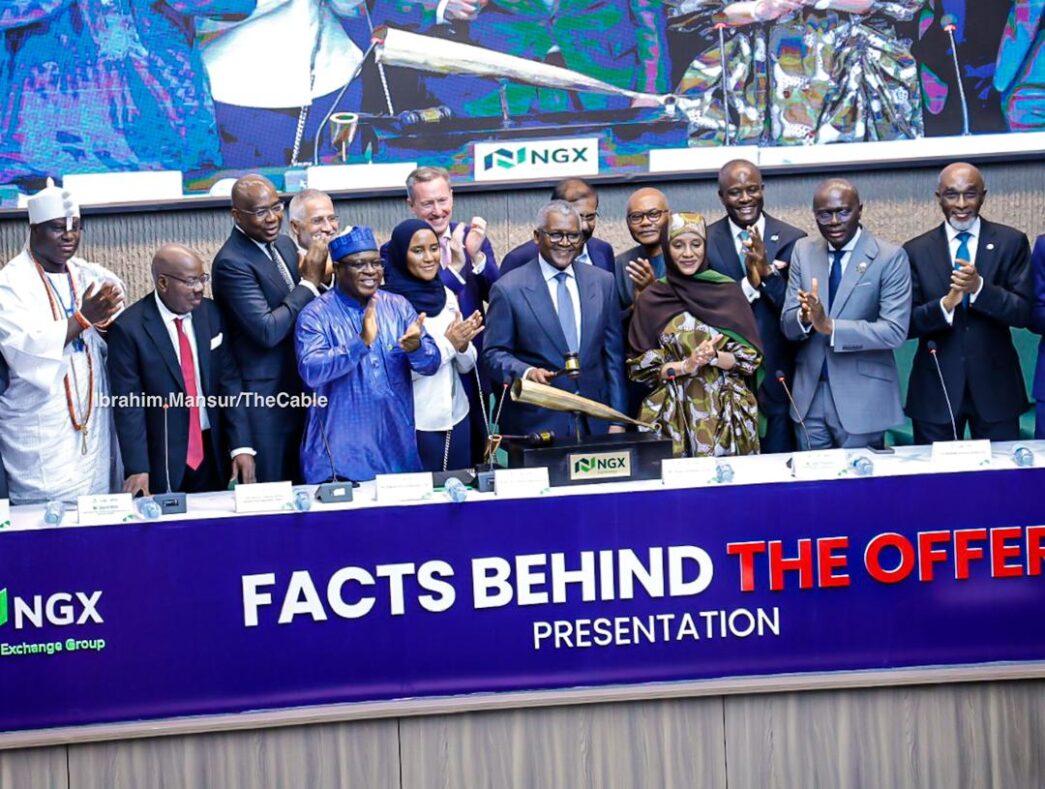
The Dangote Refinery IPO finally opened on Monday, September 14, and Nigerians did not wait around.
Within the first couple of hours, a live update from the Nigerian Exchange's NGX Invest Command Center showed more than 402,000 transactions connected to the offer. The rush was also felt on investment platforms, with Bamboo reporting login problems after receiving much higher traffic than expected from people trying to subscribe.
There has already been some confusion around how much money was subscribed during those opening hours.
Several reports interpreted an NGX figure of ₦1.476 trillion as the amount investors had already subscribed. However, another report reproducing the NGX dashboard identifies the figure as "Total Transaction Amount Remaining." If that reading is correct, roughly ₦676.3 billion of the ₦2.1525 trillion base offer had been taken at that point, equivalent to about 31.4%.
Until NGX publishes another clear subscription update, the 402,634 transaction count is easier to state confidently than claims that ₦1.5 trillion had already been raised.
Either way, the first few hours showed that demand is unlikely to be the main problem facing this IPO.
The harder question for anyone considering the shares is what exactly they are buying for ₦525.
The final Dangote Refinery IPO terms
Dangote Petroleum Refinery and Petrochemicals FZE is offering 4.1 billion new ordinary shares at ₦525 each.
The minimum application is 10 shares, so you can participate with ₦5,250. You can apply in multiples of 10 shares.
According to the official IPO website, the offer opened on September 14 and is scheduled to close on October 13, 2026. The allotment and NGX listing dates are still to be confirmed.
| Offer detail |
Final terms |
| Price per share |
₦525 |
| Shares offered |
4.1 billion |
| Minimum application |
10 shares |
| Minimum investment |
₦5,250 |
| Gross amount if fully subscribed |
₦2.1525 trillion |
| Offer opens |
September 14, 2026 |
| Offer closes |
October 13, 2026 |
| Proposed exchange |
NGX Main Board |
This is also a primary offer. Dangote or the other existing shareholders aren't selling the 4.1 billion shares to the public and taking the proceeds. The refinery is creating new shares, and the money raised goes into the business.
That distinction matters when you look at what the company plans to do with the money.
The public is not buying 10% of the refinery
This is probably the biggest thing to correct from earlier Dangote IPO stories.
Back in April, when we first wrote about the proposed Dangote Refinery listing on NGN Market, the plan being discussed was a sale of roughly 10% of Dangote Refinery.
The final offer is much smaller. Dangote Refinery currently has about 120.13 billion shares in issue. If all 4.1 billion new IPO shares are allotted, the share count rises to approximately 124.23 billion.
That means the IPO shares would represent about 3.3% of the enlarged company.
You may also see 3.41% quoted elsewhere. That percentage compares the 4.1 billion offer shares with the company's existing pre-IPO share count. Once the new shares themselves are included, the IPO represents roughly 3.30% of the company after the offer.
So the final deal differs significantly from the 10% stake and possible $5 billion offer discussed earlier in the year.
What does ₦525 actually value Dangote Refinery at?
The company has about 120.13 billion existing shares. Multiply those shares by ₦525 and you get a pre-offer equity value of approximately ₦63.07 trillion.
If all 4.1 billion new shares are issued, the enlarged share count rises to around 124.23 billion. At the same ₦525 price, that produces an indicative post-offer market capitalization of approximately ₦65.22 trillion.
This explains why you may have seen both ₦63 trillion and ₦65 trillion attached to the IPO. They refer to two different share counts.
It also helps separate the company's valuation from the amount being raised.
Dangote Refinery is raising about ₦2.15 trillion, not ₦65 trillion. The ₦65.22 trillion figure represents what the entire enlarged company would be worth if every share were valued at the IPO price.
And ₦65 trillion would make this a huge addition to the Nigerian market.
For someone deciding whether to subscribe, though, "this will be one of the biggest companies on the NGX" doesn't answer the more useful question: Is ₦525 a good price for the earnings this refinery can produce?
Analysts are already valuing the refinery above ₦525
Several investment firms have published estimates above the offer price.
CardinalStone Research placed a 12-month equity value of about ₦77.7 trillion, equivalent to roughly ₦688 per share based on the share count used in its analysis.
Chapel Hill Denham estimated a fair equity value of around ₦82.62 trillion.
Renaissance Capital Africa put its post-IPO valuation range at roughly $57.1 billion to $65.4 billion, corresponding to about ₦608 to ₦697 per share.
Those numbers make ₦525 look attractive on paper.
They are still estimates. Each model has to make assumptions about how much crude the refinery processes, the margin it earns from turning that crude into fuel, future capital expenditure, debt, product prices and whether the next expansion goes according to plan.
A target price isn't a promise about where the stock will trade.
The refinery's financials have changed very quickly
Dangote Refinery only started commercial operations in 2024, so it doesn't have a long history of stable earnings to analyze.
That makes the last three reporting periods especially interesting.
The refinery generated roughly ₦9.38 trillion in revenue in 2024 but recorded a loss of about ₦2.23 trillion.
Revenue almost doubled to around ₦18.74 trillion in 2025, although the company still ended the year with a loss of roughly ₦723 billion.
Then the numbers changed.
In the first six months of 2026 alone, Dangote Refinery reported around ₦19.13 trillion in revenue and ₦2.50 trillion in profit after tax.
| Period |
Revenue |
Profit after tax |
| 2024 |
~₦9.38tn |
~₦2.23tn loss |
| 2025 |
~₦18.74tn |
~₦723bn loss |
| H1 2026 |
~₦19.13tn |
~₦2.50tn profit |
The refinery made more revenue in six months of 2026 than it did during the whole of 2025.
Production volumes also climbed sharply. Petrol sales, for example, rose from about 3.09 million tonnes in H1 2025 to 6.06 million tonnes in H1 2026. Diesel volumes increased from about 1.76 million tonnes to 2.86 million tonnes, while jet fuel sales increased from around 2.06 million tonnes to 3.02 million tonnes.
So there is a real operating improvement behind the profit jump.
The next question is how much of it can continue.
A quick P/E calculation can be misleading here
Take the ₦2.5 trillion profit from the first half of 2026 and double it.
That gives you an annualized profit of roughly ₦5 trillion.
Compare ₦5 trillion with a ₦65.22 trillion post-offer market capitalization, and the refinery appears to be coming to market at roughly 13 times annualized H1 earnings.
That doesn't look unreasonable on its own.
But a refinery's profit can move sharply from one period to another because its economics depend heavily on refining margins.
Dangote buys crude and turns it into petrol, diesel, aviation fuel, and other products. What matters is the gap between the cost of that crude and the price at which those refined products can be sold.
That gap is often called the crack spread.
If petrol and diesel prices are strong relative to crude, a refinery can make very good money. If crude costs rise faster than product prices or global refining margins fall, profits can shrink even if the plant continues operating at high capacity.
This is one of the risks identified in the offer documents.
So annualizing six months of unusually strong earnings is useful as a reference, but it shouldn't be mistaken for a forecast.
Where will the IPO money go?
After estimated offer expenses of about ₦41.5 billion, Dangote Refinery expects net proceeds of approximately ₦2.11 trillion.
The company has earmarked all of that money for its expansion program.
Roughly ₦841 billion is expected to go toward utilities, offsites and associated infrastructure. Another ₦686.5 billion goes toward refinery process units and major equipment, while around ₦583.5 billion is allocated to construction, installation and related expansion work.
The existing Lagos refinery is currently rated at around 700,000 barrels per day, following optimization from its original 650,000 bpd design. You can see the current refinery information on Dangote Refinery's website.
The expansion covered in the offer documents is intended to take the Lagos operation to about 1.4 million barrels per day by 2029.
The full expansion program is estimated to cost about $14.27 billion.
So this IPO pays for only part of it. The company expects the balance to come from internally generated cash and other financing sources. That means investors will need to keep an eye on future debt, cash flow and expansion spending, even if the current business continues generating strong profits.
Dangote also spoke at today's NGX event about taking the group's total refining capacity to 2.1 million barrels per day by 2030, alongside plans for another refinery in Kenya.
That broader 2.1 million bpd target should not be confused with the 1.4 million bpd capacity planned for the Lagos refinery itself.
Dangote will still control the company
A small public float also means the ownership structure will remain highly concentrated after listing.
Before the IPO, Dangote Oil Refining Company holds around 65.84%, Dangote Industries about 14.90%, NNPC Limited 6.82%, and Greenview International approximately 6.50%.
Aliko Dangote's beneficial interest across related entities is expected to remain roughly 84% after the base IPO is completed.
For retail investors, this means owning shares won't translate into much influence over the direction of the company. Control will remain firmly with Dangote-related interests.
The relatively small public float could matter in another way too.
You can have a company valued at more than ₦65 trillion while only a small portion of its shares are freely changing hands. That can affect liquidity and price discovery once the shares eventually start trading.
What about dollar dividends?
Dangote spoke again today about shareholders receiving dividends in dollars.
The offer documents are more careful about how this works. The refinery reports in US dollars and says it intends to declare dividends in USD, but dividends are not guaranteed. The official IPO FAQ says dividend payments will depend on the company's performance, its cash needs, and board decisions.
The company also has flexibility over the currency in which cash distributions are ultimately paid.
For someone buying because of the "dollar dividend" story, the important thing is not to treat a future USD payment as fixed income.
The company first has to make enough distributable profit, fund its operations and expansion, meet its financing conditions and actually declare a dividend.
Retail investors may also get up to two extra shares
The offer includes a proposed Retail Investor Incentive Program.
Under the program, an eligible retail investor who receives an IPO allotment and continuously holds at least the required number of shares for 12 months may qualify for one incentive share.
Holding the required position for another 12 months may qualify the investor for one more.
The maximum is two incentive shares per eligible investor, regardless of whether that investor bought 10 shares or 10,000 shares.
The program remains subject to the required regulatory approvals.
So don't read "bonus shares" as a 20% return on your investment.
Someone who buys 10 shares and eventually receives two extra shares gets a very different percentage benefit from somebody who buys 10,000.
What happens if the offer is oversubscribed?
Given today's demand, this may become relevant quite quickly.
The base offer contains 4.1 billion shares, but the transaction allows the company to absorb up to 30% additional demand, subject to SEC approval.
That still doesn't mean every investor will automatically receive every share they apply for.
If valid applications exceed the number available, the shares can be allotted according to an SEC-approved basis of allotment.
So an application for 1,000 shares is an application, not a guarantee that 1,000 shares will eventually appear in your CSCS account.
Any excess payment would then be dealt with under the refund process in the offer documents.
How to buy Dangote Refinery shares
Subscriptions are being handled through SEC-approved receiving agents and electronic application channels.
Rather than using a random link from WhatsApp, Telegram, or X, check the official list of Dangote IPO subscription channels.
The channels include banks, issuing houses, and approved electronic investment platforms.
You generally need your BVN and investor details, choose the number of shares you want, and make full payment when submitting the application.
The minimum is 10 shares for ₦5,250. The SEC also issued a fresh warning on September 14 about unauthorised platforms trying to take advantage of interest in the IPO.
There is some history here.
Back in June, before the present offer had been approved, the SEC ordered capital market operators to stop marketing and collecting money for a purported Dangote Refinery securities offering.
At that point, no IPO application had been filed with or approved by the regulator.
The offer open today is different. It has gone through the regulatory process.
Still, only use an approved channel. Don't send subscription money to a personal account, and don't give anyone your banking PIN, password or OTP.
What happens after you apply?
Paying for an IPO application doesn't mean you can start trading the shares tomorrow.
The offer remains open until October 13.
After it closes, the applications will be processed and a final basis of allotment approved. Successful allotments will then be credited to investors through the securities settlement system.
Only after the listing takes place will investors be able to trade Dangote Refinery shares on the NGX.
The official offer timetable still lists the allotment and listing dates as to be confirmed.
Vetiva's management has indicated that the company is expected to list in November, but until a formal date is published, investors should treat November as the expected timetable rather than a fixed listing date.
So, is ₦525 a good price?
That is the real question behind all the excitement today.
The first-day transaction count shows plenty of interest. It doesn't tell us what the shares will be worth six months after listing.
At ₦525, investors are getting exposure to a refinery that has gone from large losses to ₦2.5 trillion in half-year profit, is operating at around 700,000 barrels per day and wants to double its Lagos capacity.
They are also paying for a company whose recent earnings history is short, whose profits depend heavily on refining margins, whose expansion still requires billions of dollars, and where the controlling shareholder will continue to own the overwhelming majority of the business.
There are reasonable arguments on both sides of the valuation.
CardinalStone, Chapel Hill Denham, and Renaissance Capital all arrive at values above the offer price. Their models also rely on assumptions about future earnings and expansion that still have to happen.
The IPO opened today with hundreds of thousands of transactions in its first hours. That is useful information about demand.
It doesn't replace the work of deciding what you think Dangote Refinery is worth.
For us at NGN Market, the numbers worth watching after listing will be refinery utilization, crude costs, realized product prices, refining margins, operating cash flow, debt, and how much the 1.4 million bpd expansion eventually costs.
Those numbers will tell us much more about the investment than how crowded the subscription platforms were on September 14.