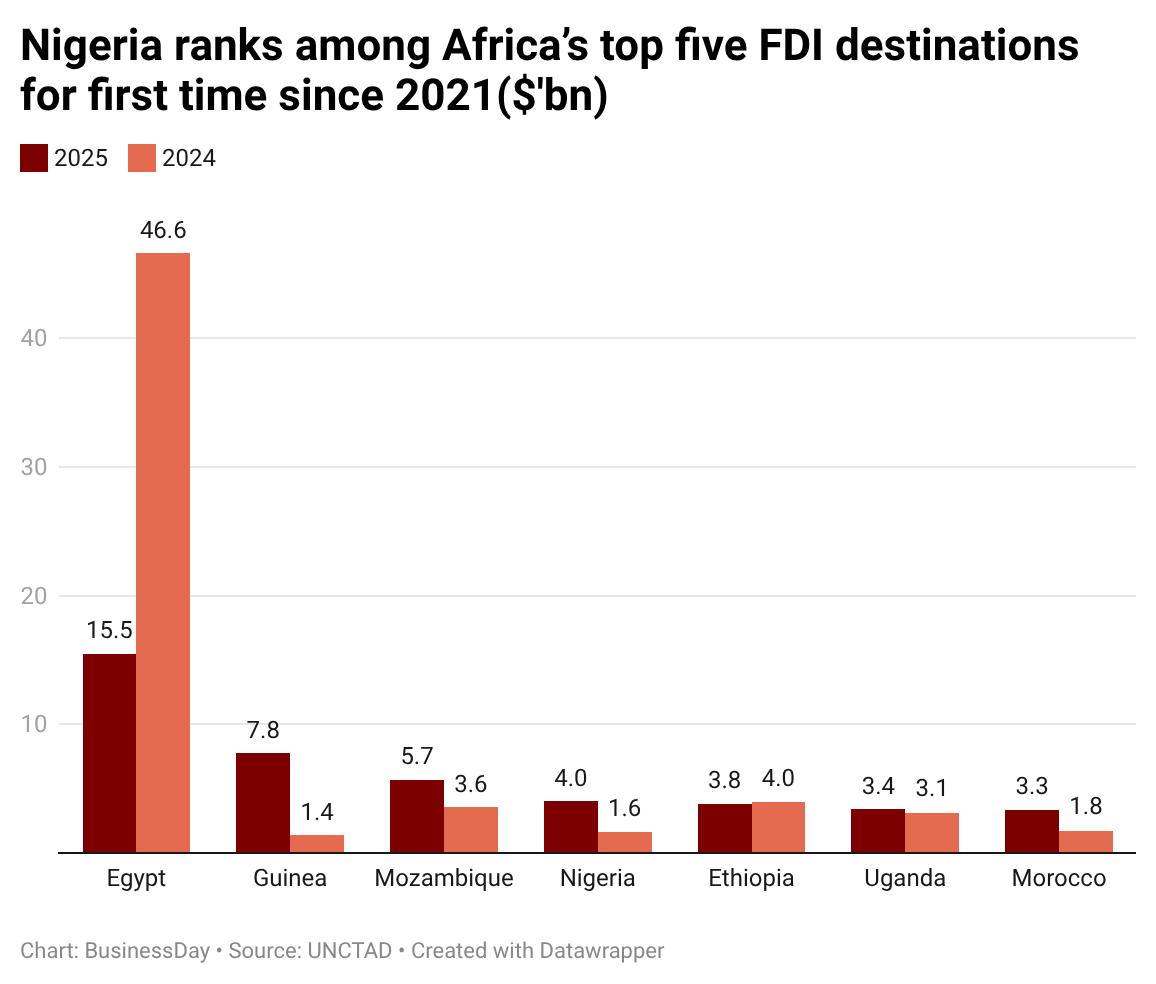
Nigeria has re-entered Africa’s top five destinations for long-term capital inflows, with Foreign Direct Investment (FDI) more than doubling to a decade-high of $4.01 billion in 2025. This surge was primarily supported by oil and gas-related international project finance deals.
An analysis of the World Investment Report 2026 by the United Nations Conference on Trade and Development (UNCTAD) revealed that FDI inflows into Nigeria rose by 148.4 percent in 2025 from $1.61 billion in 2024. This marks the highest inflow since 2014, when the country attracted $4.69 billion.
Nigeria's FDI Rebound and Ranking
In 2025, Nigeria ranked fourth among African FDI destinations, trailing Egypt, Guinea, and Mozambique. Egypt maintained its lead, attracting $15.5 billion, followed by Guinea with $7.76 billion (experiencing a 457.1 percent growth), and Mozambique with $5.69 billion. Within West Africa, Nigeria secured the second-largest inflows.
The return to the top five reflects a renewed investor interest in Nigeria's energy sector. However, these inflows remain below the levels necessary to finance the extensive infrastructure, industrialisation, and job creation required for Africa’s third-largest economy.
Key Drivers and Corporate Deals
UNCTAD highlighted that Nigeria's $4.01 billion FDI in 2025 was largely bolstered by oil and gas-related international project finance deals, including a significant project valued at approximately $2 billion. The report also noted major transactions such as Shell’s sale of its onshore oil assets to Renaissance Africa Energy, a Nigerian-led consortium, and Huaxin Cement’s acquisition of Lafarge Africa.
These inflows underscore the continued importance of extractive industries in attracting foreign capital, even as policymakers strive to draw more investment into manufacturing, technology, infrastructure, agriculture, and export-oriented sectors. Nigeria also attracted large projects in hydrocarbons, refining, battery storage, and industrial production, alongside Algeria, Namibia, South Africa, and Ethiopia.
Conversely, FDI outflows from Nigeria decreased to $1.19 billion in 2025, marking the lowest level since 2023 and indicating fewer outward investments by Nigerian companies during the year.
Government Reforms and Challenges
The rebound coincides with the Federal Government's intensified efforts to attract foreign capital, aligning with its ambitious plan to build a $1 trillion economy by 2030. Achieving this target will necessitate substantially higher and more consistent foreign investment.
Since 2023, the government has implemented a series of reforms to rebuild investor confidence. These include foreign exchange market adjustments, initiatives to enhance fiscal stability, tax reforms, energy-sector incentives, and measures to ease business constraints. UNCTAD noted Nigeria's introduction of performance-based tax credits for upstream petroleum companies, linking fiscal benefits to cost efficiency, and a more selective approach to investment incentives and special economic zones.
Additionally, Nigeria adopted a minimum effective tax rate of 15 percent for multinational enterprises with revenues exceeding €750 million, in line with global tax reforms. This policy shift aims to ensure investment incentives deliver measurable economic benefits rather than merely reducing tax obligations for multinational corporations.
However, sustaining this recovery hinges on whether these reforms translate into a more predictable investment climate. Investors continue to cite foreign exchange volatility, high operating costs, weak infrastructure, insecurity, policy uncertainty, and regulatory bottlenecks as significant impediments.
Broader African FDI Landscape
Across Africa, FDI inflows declined to $70 billion in 2025 from an exceptional $94 billion in 2024. Despite this year-on-year decrease, the 2025 figure remained historically robust, standing approximately one-third above the average recorded between 2010 and 2024. UNCTAD clarified that the 2024 total was inflated by a few unusually large transactions, notably Egypt’s Ras El-Hekma construction and real estate megaproject.
Excluding exceptional peaks, 2025 represented Africa’s strongest underlying FDI performance in recent decades. North African inflows fell 56 percent to $22 billion in 2025, largely due to the high base set by Egypt’s Ras El-Hekma project in the prior year. Egypt remained Africa’s largest FDI recipient, while Morocco attracted about $3.3 billion, supported by manufacturing and automotive investments.
In East Africa, Ethiopia maintained inflows of approximately $4 billion and saw a significant increase in announced greenfield projects. Uganda attracted $3.4 billion, driven by investments in oil refining and battery storage. Mozambique’s inflows rose strongly, propelled by hydrocarbons and liquefied natural gas projects, while Angola returned to positive inflows of about $1.1 billion after recording negative flows in 2024.
Conversely, South Africa recorded negative FDI inflows of about $2.3 billion, primarily due to intracompany financial flows, profit repatriation, and merger-and-acquisition transactions. Despite this, the country remained an important destination for announced projects in manufacturing, energy, and services. Global FDI outflows remained concentrated among a small group of economies in 2025, with the United States remaining the largest source.