Nigeria’s cost of living crisis has deepened over the past decade as inflation, naira depreciation, fuel subsidy removal, and stagnant incomes eroded household purchasing power. In the fourth part of its report, "10 Years of Money Market and Living Costs," Comercio Partners examines how rising costs have stretched household finances. The burden falls heavily on the 87% of workers in the informal economy who lack minimum wage protection.
The Wage and Inflation Disconnect
Between 2015 and 2025, headline inflation in Nigeria averaged above 16% annually, hitting a 28-year high of 34.8% in 2024. Meanwhile, the naira weakened from approximately ₦197/$ in 2015 to ₦1,500 by 2024, averaging around ₦1,377 as of May 2026. These forces converged to produce a severe collapse in household purchasing power.
Nigeria’s minimum wage rose from ₦18,000 in 2015 to ₦70,000 in July 2024, representing a 133% nominal gain. However, cumulative inflation in the five years to December 2025 alone reached 152.7%, meaning the real minimum wage declined in purchasing power every year from 2019 to 2024. During the 2024 strike, the Nigeria Labour Congress demanded ₦494,000, which was nine times the negotiated settlement.
This formal wage debate only directly impacts about 12.7% of Nigeria’s workforce. The remaining 87% of the workforce consists of informal traders, artisans, smallholder farmers, and transport operators who have no wage floor and remain entirely exposed to market forces.
Six Critical Household Pressure Points
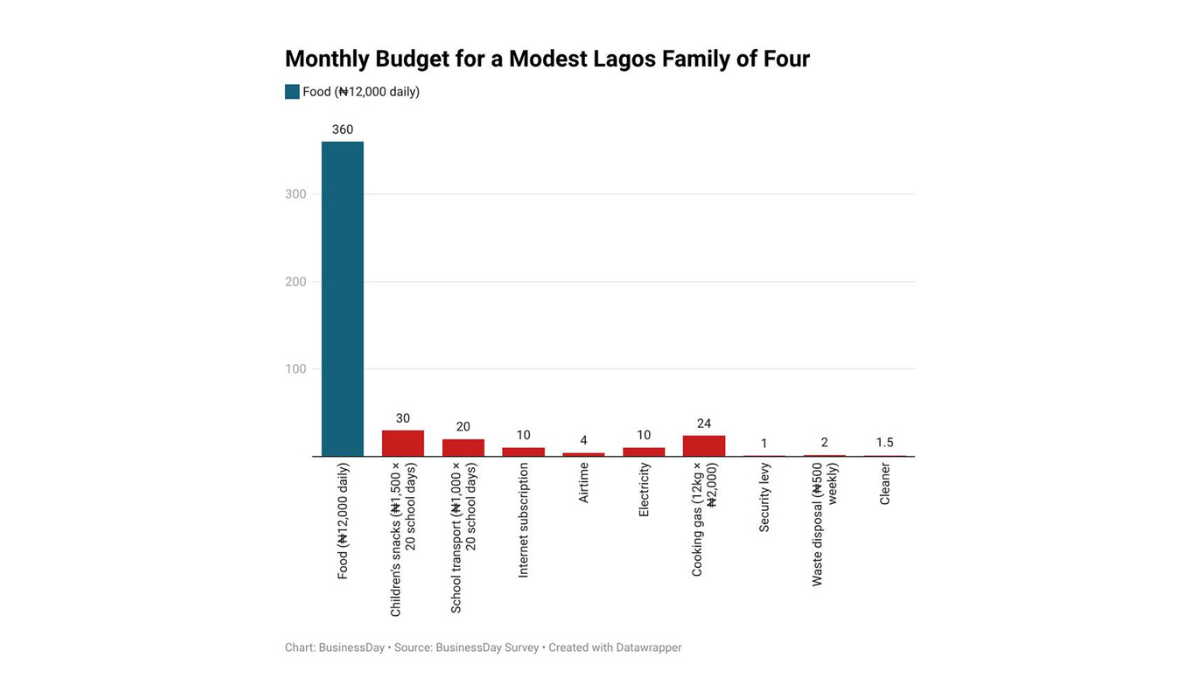
The weight of inflation landed hardest on essentials. Prior to the National Bureau of Statistics CPI rebase in January 2025, food alone accounted for 51.8% of the household basket. The Comercio Partners report highlights six key areas of pressure.
First, rents in Lagos surged 50% to 200% over the 24 months leading to early 2026. The income-to-rent ratio climbed to approximately 70%, far exceeding the 30% affordability threshold recommended by the United Nations. A one-bedroom apartment in Yaba now costs between ₦700,000 and ₦1.2 million per year, while a two-bedroom apartment in Ikeja ranges from ₦1.5 million to ₦2.5 million per year.
Second, food inflation peaked at 40.87% year-on-year in June 2024, driven by fuel subsidy removals that raised logistics costs. Prices of rice, beans, cooking oil, and tomatoes more than doubled between 2023 and 2024.
Third, petrol prices rose from ₦87 per litre in 2015 to ₦195 before the July 2023 subsidy removal pushed it to ₦617 overnight. By April 2025, the national average reached ₦1,239 per litre, representing a 14-fold increase from 2015.
Fourth, mobile data costs doubled from ₦287 to ₦575 per gigabyte between 2024 and 2025. The Nigerian Communications Commission approved a 50% tariff increase in early 2025, and MTN attempted a 200% hike on its 15GB weekly bundle from ₦2,000 to ₦6,000 before a partial reversal. Nigerians now spend an estimated ₦7.62 trillion ($5.58 billion) annually on mobile data.
Fifth, mid-range private school fees in Lagos now range from ₦600,000 to ₦1.8 million per child per year, excluding uniforms and books. For a household earning the annual minimum wage of ₦840,000, tuition for a single child would absorb 70% to 200% of total income.
Sixth, out-of-pocket health spending exceeds 70% of total healthcare expenditure in many states, according to the World Health Organization. Inflation and naira depreciation have driven up the cost of imported pharmaceuticals and diagnostics, pushing many families past the WHO "catastrophic" health spending threshold of 40% of disposable income after food and housing.
Deferred Life Milestones and Savings Erosion
A Chatham House analysis from March 2025 noted that food prices were over 80% higher than at the 2023 election, while petrol had quadrupled. Although the NBS CPI rebase of January 2025 reduced the official headline rate from 34.80% to 24.48% overnight by changing basket weights, actual prices remained elevated, eventually easing to 15.15% by December 2025.
These economic pressures have delayed key milestones like homeownership. The Central Bank of Nigeria's Monetary Policy Rate stood at 26.5% in May 2026, down from a high of 27.5% throughout 2025, keeping mortgage finance out of reach for most citizens while construction costs continue to rise.
Finally, emergency savings have been severely depleted. A Piggyvest report revealed that 60% of Nigerians currently have no emergency funds at all, while only 15% have enough savings to cover six months or more of expenses.