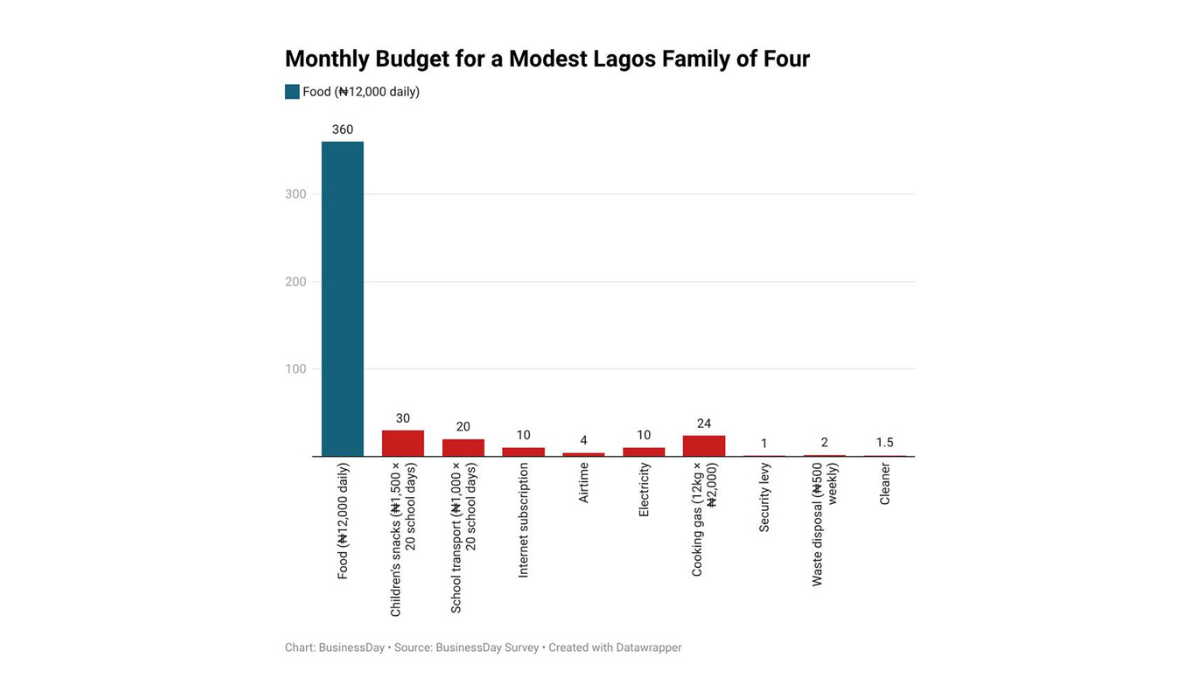
Ibrahim Olarinrin, a 38-year-old Lagos resident earning N300,000 monthly, finds his salary insufficient to feed his family of four, which costs approximately N360,000 for food alone. When other essentials like transportation, cooking gas, and electricity are included, the family's monthly needs reach about N462,500, leaving a significant deficit before rent, school fees, or healthcare are considered.
This situation reflects a broader economic shift in Nigeria, where working individuals and families are struggling to maintain a basic standard of living despite being employed. The country is grappling with an income adequacy problem, not just a cost-of-living crisis.
The Rise of the Survival Wage
Data indicates that a family of four in a mid-sized Nigerian city needs between N349,000 and N513,000 monthly for basic living costs. This figure escalates to N605,000 and N731,000 when rent and school fees are factored in. This contrasts sharply with Nigeria's statutory minimum wage of N70,000 and average formal sector earnings of approximately N339,000 per month.
Consequently, many households find themselves employed yet unable to achieve financial stability, a phenomenon known as 'in-work poverty'. This is driven by the rapid increase in the cost of essentials, which has outpaced wage growth, particularly in urban centres.
Budgetary Disconnect and Fund Leakage
Despite the Federation Account Allocation Committee (FAAC) disbursing over N58 trillion between 2023 and 2025, and sharing N2.036 trillion in March 2026 alone, a significant portion of these funds does not reach the citizens effectively. The analogy of a large household with a leaking agbada illustrates how money allocated to federal, state, and local governments can be lost through various channels.
The constitutional allocation formula dictates that roughly 52.68% goes to the federal government, 26.72% to states, and 20.60% to local governments, with an additional 13% derivation for oil-producing states. However, the article questions where this substantial revenue ultimately goes, given the widespread economic hardship and hunger.
Economic Repercussions of Eroded Purchasing Power
The erosion of household purchasing power has significant economic consequences. Families are compelled to spend a larger share of their income on necessities, leaving less for savings, investment, and discretionary consumption. This directly impacts economic growth, as household consumption is the largest component of Nigeria's economy.
The ripple effects include weaker demand for retailers, struggles for small businesses, declining household savings, reduced bank deposits, and postponed spending on healthcare and education. Furthermore, the diminished disposable income hinders social mobility, limiting opportunities for asset building and investment in future generations.
The core issue for policymakers is the widening gap between household earnings and the current cost of living. The narrative of Nigeria's economic challenges is shifting from solely focusing on rising prices to addressing the fundamental inadequacy of income for a growing number of working Nigerians.