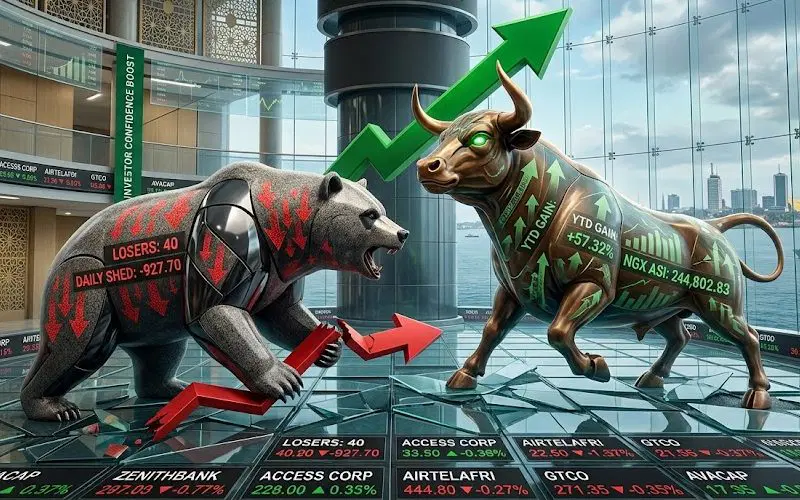
The Nigerian equities market concluded the first trading week of June 2026 with a downturn, as the NGX All-Share Index (ASI) fell by 3.11% to settle at 242,593.31 points. This decline was primarily driven by sustained profit-taking across the banking, industrial, and oil and gas sectors.
The benchmark index lost 7,792.16 points from the previous week’s close of 250,385.47 points. Consequently, market capitalization decreased by 3.06% to N155.59 trillion, erasing approximately N4.91 trillion in investor wealth.
Despite a modest recovery on Friday, June 5, where the market gained N234.73 billion, the week was marked by four consecutive sessions of losses. Earlier in the week, the market experienced significant drops, losing N1.81 trillion on June 1, N2.28 trillion on June 3, and an additional N580.65 billion on June 4 as investors intensified profit-taking in several high-performing stocks.
Trading activity remained relatively robust despite the correction. Total turnover increased sharply to 3.97 billion shares valued at N175.66 billion, traded in 343,587 deals, compared to 2.40 billion shares worth N111.48 billion traded in 241,313 deals the previous week.
Market breadth weakened significantly, with only 23 stocks advancing compared to 65 decliners, while 58 equities closed unchanged. The Nigerian equities market had entered June under pressure after a strong five-month performance, with investors locking in gains following a rally that pushed the benchmark index above 250,000 points in May.
Equity market activity saw a progressive decline through most of the week. Trading volume peaked at 1.13 billion shares valued at N44.25 billion on June 1 before moderating to 608.45 million shares worth N32.01 billion by the end of the week. Investor sentiment was largely negative between June 1 and June 4.
However, market breadth improved sharply on Friday, with 39 stocks advancing against 11 decliners, offering a temporary respite from the week’s selloff.
Sectoral Performance
Sector performance was broadly negative, with investors reducing exposure to several high-performing segments. The Oil and Gas Index was among the worst performers, impacted by heavy selloffs in Aradel Holdings and Eterna. Nairametrics reported that Aradel plunged 9.51% and Eterna lost 9.85% on Thursday alone, dragging the sector down 4.90% in a single day.
The Banking Index also faced pressure as investors booked profits in First HoldCo, Wema Bank, and Fidelity Bank. The Industrial Goods Index weakened following a sharp decline in BUA Cement, while consumer goods stocks showed mixed performance. The NGX Sovereign Bond Index was the only index that closed flat.
Top Performers and Laggards
International Energy Insurance Plc emerged as the week’s standout performer, gaining 60.62% to close at N7.26. Abbey Mortgage Bank Plc followed with a 47.24% appreciation to N9.35. Other notable gainers included Tripple Gee and Company Plc (up 9.80%), Ikeja Hotel Plc (up 9.45%), and R.T. Briscoe Plc (up 8.86%).
On the downside, BUA Cement led the losers, declining by 10.00%. Trans-Nationwide Express saw a 9.85% drop, followed by John Holt Plc (down 9.73%), Red Star Express (down 9.71%), and Deap Capital Management (down 9.15%).
The Nigerian stock market experienced a significant selloff at the start of June, losing N5 trillion in market value within a week. This decline followed a substantial year-to-date rally of over 60% in 2026, which saw the market reach record highs in April and May. Institutional investors and fund managers, having enjoyed substantial gains, engaged in widespread profit-taking from major financial and consumer stocks.
This capital flight coincided with a rise in US interest rates, triggering outflows from markets like Nigeria into dollar-denominated assets. Fixed-income assets, such as 91-day T-Bills yielding 16%, became attractive risk-free investments, prompting a shift away from equities.
While banking stocks generally performed well amid high interest rates, consumer and industrial stocks struggled due to FX risks, supply chain disruptions, and weak domestic demand. Global investors also faced liquidation in US tech stocks and cryptocurrencies due to broader market selloffs triggered by stronger-than-expected US employment data, which reduced the likelihood of Federal Reserve rate cuts.
Bitcoin experienced a sharp downturn, falling below $60,000, with Spot Bitcoin ETFs seeing significant outflows. This institutional selling in riskier assets was partly driven by the need to finance the AI infrastructure boom, with significant investments flowing into AI stocks and chip makers.
Friday’s rebound, driven by insurance and banking stocks, marked the first positive trading session since the implementation of the T+1 settlement regime. The gain of N234.73 billion partially offset the over N5.14 trillion lost in the preceding four trading sessions. Despite the recovery, the NGX remained below its all-time high of 252,508 points reached on May 13, 2026, though its year-to-date return of 55.90% remains strong among global equity markets.