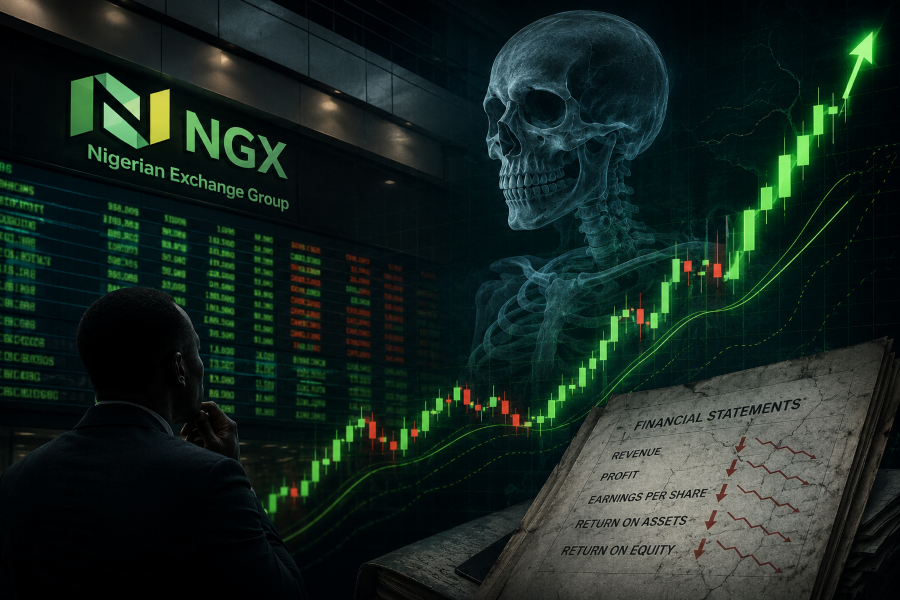
Some of the Nigerian Exchange’s biggest gainers in 2026 share a common characteristic: their share prices are rising significantly faster than the businesses supporting them. Many of these companies have reported years of losses, minimal or no revenue, delayed financial accounts, or concerns regarding debt and ownership.
Despite these weaknesses, their shares have surged between 50% and more than 1,000%. Nairametrics defines these as “zombie stocks”: listed companies whose businesses appear dormant, distressed, or financially weakened, yet their share prices experience rallies.
Understanding “Zombie Stocks”
The “zombie stock” label highlights a sharp disconnect between market price and current operating performance, though it does not imply every company is insolvent or incapable of recovery. In a typical zombie rally, investors are often buying expectations rather than proven earnings, frequently driven by rumors of restructuring, acquisition speculation, new ownership, or recapitalization plans.
A rising share price alone does not qualify a stock as a zombie. Strong companies can rally due to improved earnings or market corrections of undervaluation. Nairametrics identified these zombies by comparing share-price performance with key financial metrics such as revenue, profitability, earnings per share, retained earnings, returns on equity and assets, debt obligations, and valuation multiples.
Additional factors considered included delayed accounts, going-concern warnings, prolonged suspensions, free-float deficiencies, and ownership disputes. The clearest candidates exhibit several of these weaknesses while attracting unusually strong demand.
Identifying Current Zombie Stocks
Fortis Global Insurance (FTGINSURE) has gained about 1,270% year-to-date, yet its financial performance remains weak. The company recorded sustained losses from 2021 through the first quarter of 2026 and has a trailing EPS of negative N0.13. Its rally is partly influenced by a four-for-one share consolidation and its return to trading after a six-year suspension, which mechanically increases the price per share without adding economic value. Fortis is also working to settle a N5.74 billion obligation from an old bond.
DAAR Communications has seen a gain of about 273% in 2026, including a sharp rally in July. The company reported losses every year from 2021 to 2025, accumulating an estimated deficit of N6.35 billion, though it posted a profit of about N335 million in the first quarter of 2026. An unresolved shareholding dispute is also under regulatory review, positioning DAARCOM as a speculative recovery candidate.
Morison Industries (MORISON) has gained about 101.94% in 2026 despite a trailing EPS of negative N0.03. It recorded losses in four of the past five years, returning a small N12.3 million profit in 2025 before slipping back into a loss in the first quarter of 2026. Morison trades at approximately 10.58 times book value and 25.42 times sales. Its 2025 accounts were delayed, and auditors highlighted material uncertainty over its ability to continue as a going concern, with accumulated losses of about N903.9 million. These issues firmly place Morison in the zombie category.
Critical Minerals Financing Company (CMFC) has gained about 82.11% year-to-date with little operating activity. The company reported no revenue between 2021 and 2024 and posted losses every year from 2021 to 2025. Its return on equity is negative 19.3%, and return on assets is negative 6.3%. Despite this, the stock trades at about four times book value, indicating investors are paying for a future business not yet reflected in financial statements.
Omatek Ventures (OMATEK) has gained about 76.11% in 2026 despite an EPS of negative N0.02. Revenue declined from N3.75 million in 2021 to zero in 2025, with profit after tax being negative every year since 2021. Its price-to-sales ratio exceeds 28,000 times, illustrating a significant market value assigned to a company generating virtually no revenue.
Former Zombies That Recovered
Nigeria has experienced this phenomenon before. In February 2018, Nairametrics identified “zombie stocks” like Unity Bank, Skye Bank, Japaul, UNIC Insurance, and Union Dicon Salt (UNIONDICON), whose rallies were driven by expectations of acquisitions or restructuring. Eight years later, some remained distressed, while others improved.
ABC Transport, named in 2018, has shown recovery. Its revenue rose from N6.6 billion in 2021 to nearly N16 billion in 2025, an estimated five-year compound annual growth rate of 24.85%. It returned to solid profitability in 2024 and 2025, supporting its roughly 90% rally in 2026.
Japaul Gold and Ventures (JAPAULGOLD) has also changed considerably. Revenue grew roughly tenfold to almost N4.5 billion in 2025, with profit after tax positive in 2024 and 2025. Total assets increased from N13.1 billion to N33.5 billion, and its 40.3% gain in 2026 is more restrained than other speculative names.
Borderline Cases and Governance Concerns
Not all weak companies with rising share prices fit neatly into the “zombie” category. FTN Cocoa, another 2018 name, has gained about 70%, but its EPS remains marginally positive. Neimeth Pharmaceuticals and Trans-Nationwide Express have also rallied despite negative earnings. Union Dicon Salt (UNIONDICON) and Tantalizers also fall into a grey area, attracting turnaround expectations without clear evidence in available results.
Zombie rallies thrive in environments with limited information. When companies delay results, remain suspended for extended periods, fail to meet free-float requirements, or do not clearly explain ownership changes and restructuring plans, speculation fills the void. Better governance, including timely accounts, transparent disclosure of new revenue sources, major ownership changes, and the use of fresh capital, is crucial for investors to assess risk.
Regulators also need to enhance transparency regarding suspensions, unusual price movements, and delayed filings. The lesson from 2018 is that while some zombies like ABC Transport and Japaul can rebuild and justify investor interest, a genuine turnaround must be visible through revenue growth, stronger cash flow, lower debt, timely accounts, and sustainable profits. A rising share price alone is not proof of a recovering business.