The Federal Government has granted United Nigeria Airlines approval for several international routes, including services to New York, Dubai, and Canada. This move is intended to strengthen Nigerian carriers and enhance their participation in international passenger traffic.
Minister of Aviation and Aerospace Development, Festus Keyamo, announced the approvals during the unveiling of two new Boeing 737-800 Next Generation aircraft by the airline. He stated that these route approvals are a component of broader efforts to reposition domestic airlines for more effective competition on international routes, which have historically been dominated by foreign operators.
“We are giving United Nigeria Airlines about four or five routes. We are giving them New York, Canada, Dubai and some other viable destinations,” Mr. Keyamo said. He highlighted that foreign airlines currently transport between 90 and 95 percent of passengers traveling from Nigeria to international destinations.
The government's aviation policy aims to remove barriers that have previously hindered the growth of domestic operators. Mr. Keyamo also linked the route approvals to ongoing initiatives to improve access to aircraft acquisition and leasing opportunities for Nigerian airlines. President Bola Tinubu has approved the establishment of a Nigerian aircraft leasing company to assist domestic carriers through government-backed arrangements, intending to alleviate financing challenges.
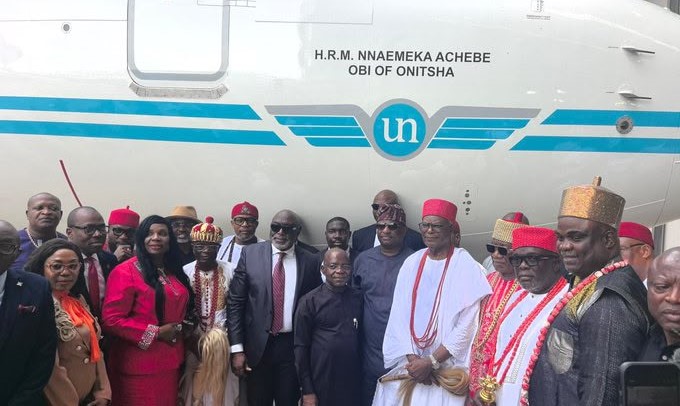
United Nigeria Airlines unveiled two Boeing 737-800NG aircraft, named in honour of the Obi of Onitsha, Nnaemeka Achebe, and novelist Chinua Achebe, as part of its fleet expansion. This expansion occurs despite the airline reporting losses of approximately N10 billion over a three-month period, attributed to increased operating costs and surging aviation fuel prices.
In parallel, Professor Obiora Okonkwo, Executive Chairman of United Nigeria Airlines, urged the Federal Government for stronger financial and policy support for local airlines, citing high operating costs as a constraint on industry growth. He noted that Nigerian carriers face one of the most expensive aviation environments globally, as indicated by an IATA report.
Professor Okonkwo also called for aviation regulatory funds, particularly those for the Nigeria Civil Aviation Authority (NCAA), to be retained within the sector for infrastructure and operational improvements, rather than being transferred to the Federal Government's consolidated revenue account. He mentioned that the ongoing conflict in the Middle East has added financial pressure due to disrupted global aviation operations and increased costs.
Despite these challenges, Okonkwo indicated that Nigerian airlines are gradually regaining access to international aircraft financing. He recalled past difficulties in securing support from foreign lessors but noted that recent engagements by the Federal Government and aviation authorities have helped restore confidence in Nigeria's aviation market.
A Boeing representative, Moore Ibekwe, acknowledged Nigeria's progress in aviation reforms, including enhanced aircraft financing access, technical capabilities, safety standards, and regulatory environment. Boeing has launched a training program in Nigeria for pilots and engineers. Ibekwe projected that Africa will require approximately 1,200 new aircraft over the next 20 years, presenting significant growth opportunities for Nigerian airlines.
The Federal Government is also collaborating with the Abia State Government on the development of a proposed Abia International Airport, with plans for United Nigeria Airlines to establish a major hub there. Additionally, efforts are underway to transform the Akanu Ibiam International Airport in Enugu into a dedicated cargo hub, with discussions for direct cargo flights between China and Enugu.