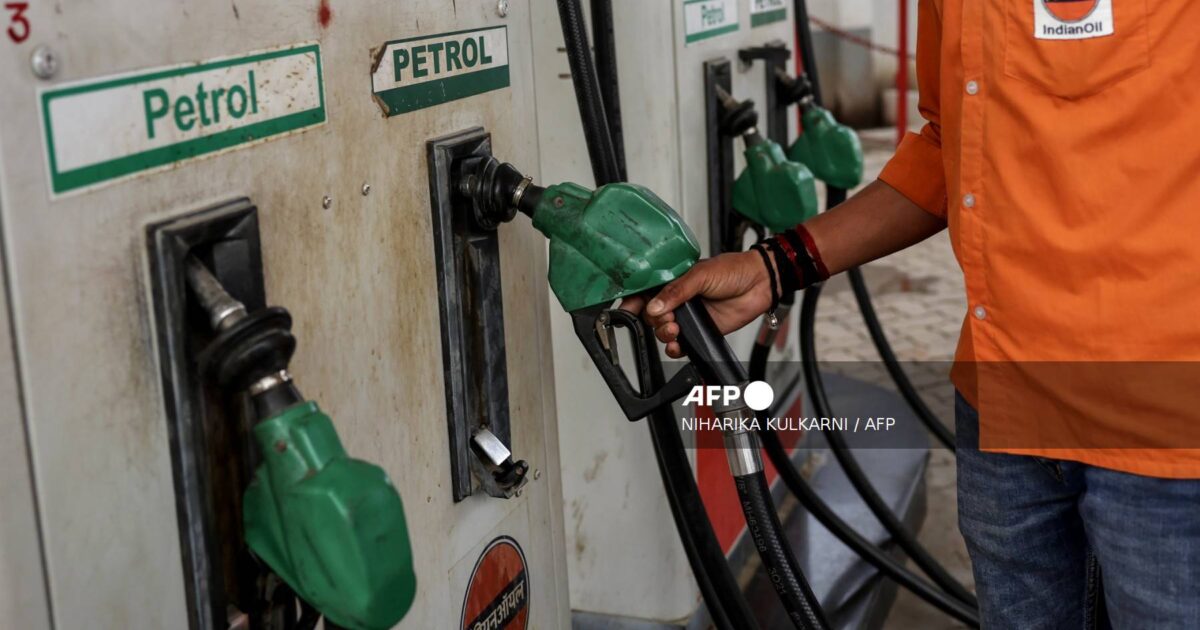
Global crude oil prices climbed by over 7% on Monday, April 13, 2026, following an order by US President Donald Trump directing the Navy to begin a blockade of all ships entering or leaving the Strait of Hormuz.
Brent crude futures rose to $101.91 per barrel, while West Texas Intermediate (WTI) increased to $104.16 per barrel. This surge represents a 7.05% increase for Brent and a 7.86% increase for WTI.
Trump ordered the closure of the Strait of Hormuz, a crucial waterway through which approximately 20% of the world’s oil passes. This action was taken after talks between the United States and Iran collapsed in Islamabad, Pakistan, in the early hours of Sunday.
Trump stated that the blockade would go into effect by 10:00 AM, with other nations working to prevent Iran from selling oil. He emphasized that the blockade would only apply to vessels travelling to or from Iranian ports.
The steep rise in oil prices follows a sharp decline on April 8, when Iran and the US had reached a ceasefire. During that period, Brent crude and WTI fell by more than 15%, pushing Nigerian crude and major oil contracts below $95 per barrel. Prices have now surged back above the $100 mark.
In a separate but related development, operations resumed on Monday at a major gas facility in Iraq’s Kurdish region. Dana Gas announced the resumption of production at the Khor Mor gas facility after more than a month of intermittent operations. Supplies were suspended on February 28 due to the outbreak of war.
The Khor Mor complex, which supplies most of Kurdistan’s power stations, has been targeted several times in recent years in attacks blamed on pro-Iran armed groups.
The market reaction saw West Texas Intermediate (WTI) futures up 7.4 percent at $103.69 a barrel and Brent North Sea Crude up 6.9 percent at $101.78 a barrel around 0715 GMT.
Equities fell globally, with Tokyo’s Nikkei 225 down 0.7 percent at 56,502.77, Hong Kong’s Hang Seng Index down 1.2 percent at 25,587.30, and London’s FTSE 100 down 0.5 percent at 10,544.99. Shanghai’s Composite edged up 0.1 percent to 3,988.56.
Analysts noted that the collapse of talks and the subsequent blockade were expected to keep prices elevated. Malcolm Melville of Schroders warned that even if the war ends, prices would likely remain high for some time due to shut-in production and damage to facilities. He stated, “While shipping levels could return to normal quickly, it will take weeks or even months for production levels to return to normal given the 10 million barrels a day of shut-in production and damage to some facilities.” He added, “This should mean that front-month oil prices (i.e. oil for near-term delivery) are unlikely to fall to pre-conflict levels quickly. The uncertainty about when production will return should support prices.”
Saxo Markets' Charu Chanana commented, “It was always a tall order to secure a deal in one sitting given the number of sticking points still on the table, including missiles, nuclear restrictions, proxy dynamics, the Strait of Hormuz, and sanctions. The fact the talks happened at all matters. There is still a chance negotiations restart, especially with some reports suggesting the two sides were not far apart on at least some points.”
The US consumer price index had previously spiked at 3.3 percent in March, its highest since May last year, highlighting the conflict's impact on prices.