Nigeria’s broad money supply (M3) has reached N124.99 trillion as of April 2026, a rise from N123.12 trillion recorded in February 2026. This expansion in liquidity occurs despite the Central Bank of Nigeria's (CBN) ongoing monetary tightening efforts.
The latest monetary data reveals a nearly N1.87 trillion increase in broad money supply over the two-month period. The CBN did not publish data for March 2026.
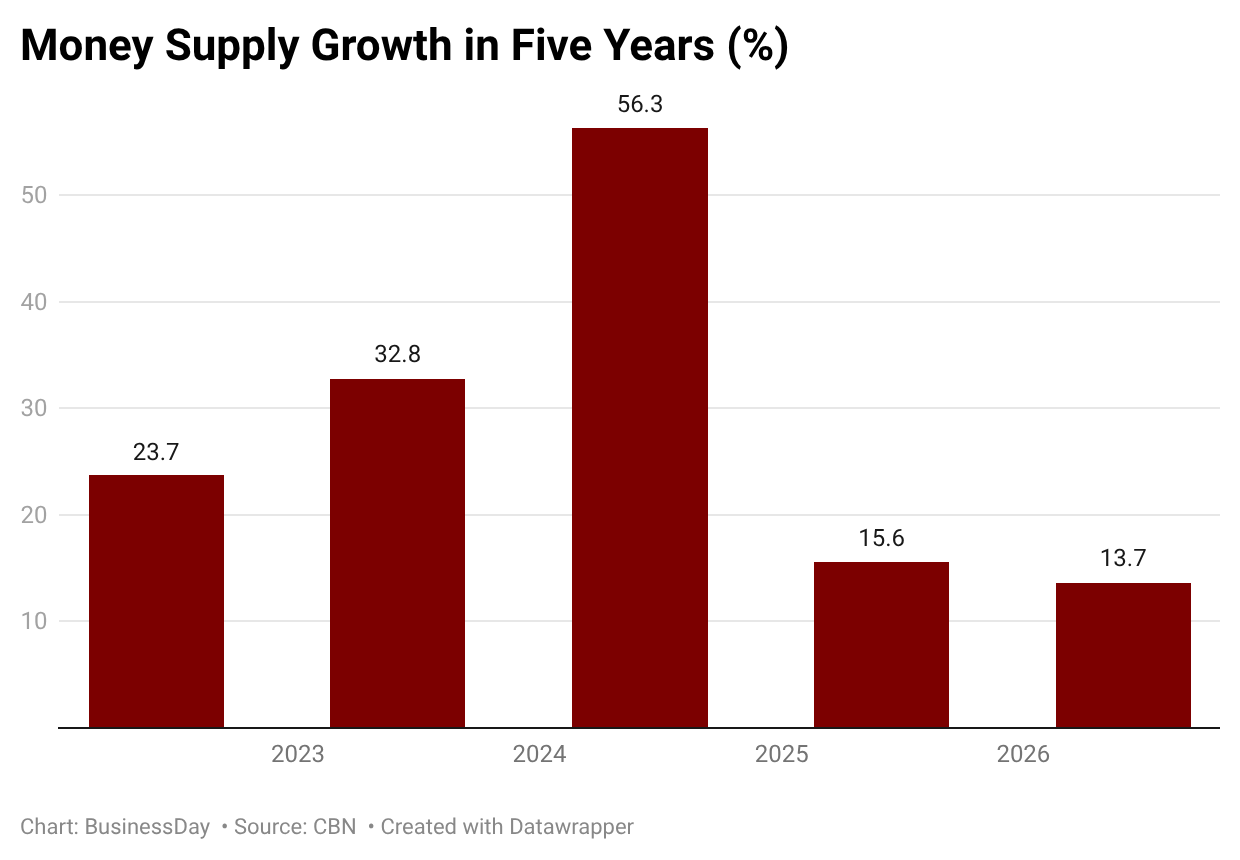
Broad money, or M3, encompasses all available liquidity for spending, investment, and lending, including currency in circulation, demand deposits, savings, time deposits, and foreign currency holdings. The year-on-year increase in money supply from N119.22 trillion in April 2025 to N124.99 trillion in April 2026 highlights sustained monetary expansion over the past year.
Narrow money supply (M2) also saw an increase, rising to N124.98 trillion in April 2026 from N123.11 trillion in February 2026. However, net foreign assets decreased to N24.01 trillion in April from N25.57 trillion in February 2026. Conversely, net domestic assets saw a significant rise to N100.97 trillion from N97.55 trillion during the same timeframe.
These figures suggest that while foreign asset positions weakened, domestic liquidity conditions remained robust, bolstered by growth in domestic assets and overall financial system liquidity. This trend persists even as the CBN aims to balance inflation management with economic growth support.
Aggressive Liquidity Tightening
In a significant move to manage liquidity, the CBN conducted one of its most aggressive Open Market Operations (OMO) auctions on May 21, 2026, withdrawing a total of N3.692 trillion from the system across two instruments. This action represents a dramatic escalation of its liquidity tightening campaign.
Investor demand significantly outstripped the N600 billion offered across a 33-day and a 138-day bill, with total subscriptions reaching N3.692 trillion. This indicates a strong appetite for the CBN's high-yield instruments among banks.
Specifically, the 33-day bill received subscriptions totaling N1.525 trillion against a N300 billion offer, resulting in a 5.1x oversubscription. The CBN accepted the full amount at a marginal rate of 21.57%. The longer 138-day bill attracted even greater interest, with N2.168 trillion in bids against a N300 billion offer, a 7.2x oversubscription, accepted at a marginal rate of 19.97%.
Notably, the short-tenor bill commanded a higher rate (21.57%) than the longer-dated instrument (19.97%). The CBN's decision to accept all subscriptions, rather than rationing as seen in a previous auction on May 12, signals a deliberate strategy to drain excess liquidity from the banking system, aligning with concerns over inflationary money supply.
The combined net sales of N3.692 trillion in a single day mark an extraordinary intervention. Further reinforcing this picture, CBN financial data shows the Standing Deposit Facility (SDF) fell from N6.103 trillion on May 20 to N5.797 trillion on May 21, indicating a substantial reduction in surplus cash parked by banks with the apex bank.