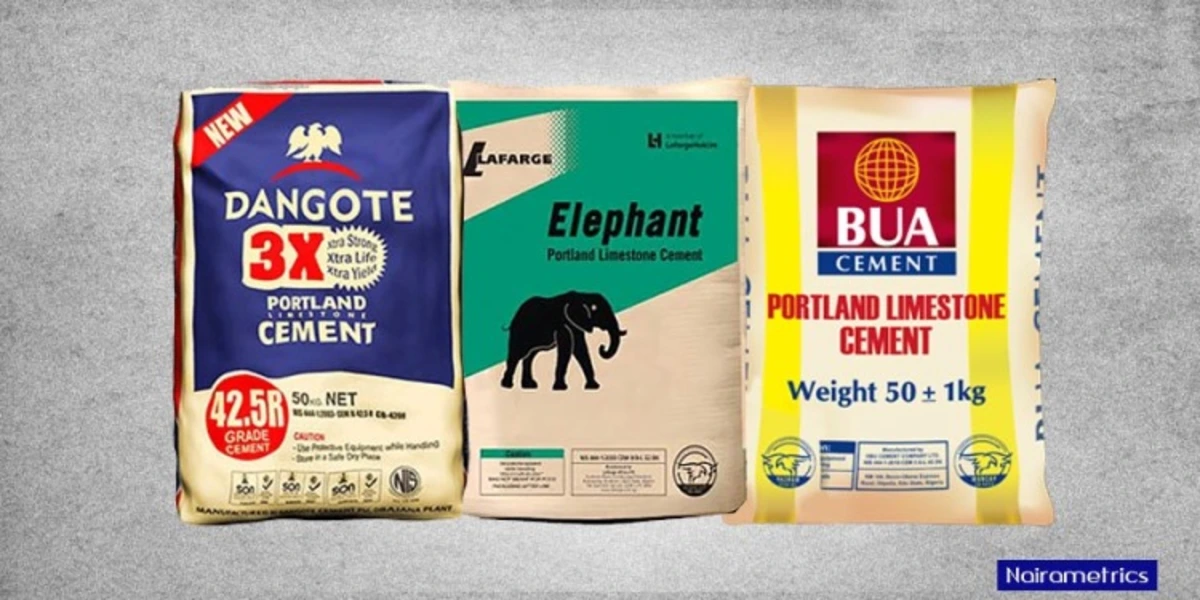
Nigeria's three major listed cement manufacturers generated a combined N3.2 trillion in revenue during the first half of 2026. This represents a 26.5% increase from the N2.5 trillion recorded during the same period in 2025, driven by price hikes and ongoing construction projects.
According to the unaudited financial statements filed by Dangote Cement, BUA Cement, and HBM Nigeria, the performance was driven by a combination of higher sales volumes and price increases. All three listed manufacturers recorded double-digit revenue growth and expanded their production capacity.
Revenue Performance Across Major Producers
Dangote Cement reported Nigeria-only revenue of N1.8 trillion, representing a 25.2% increase from the previous year. Including its operations across 21 African countries, the group's total revenue reached N2.5 trillion, with Nigeria contributing over 70% of the total. CEO Arvind Pathak attributed the performance to disciplined execution and sustained demand.
BUA Cement posted a 25.6% year-on-year revenue increase to N728.9 billion. Notably, its bulk cement sales surged from N236 million in the first half of 2025 to N40.2 billion in the first half of 2026, reflecting higher participation in infrastructure projects. Managing Director Yusuf Haliru Binji stated that ongoing process optimization will support performance in coming quarters.
HBM Nigeria, which changed its name from Lafarge Africa in May 2026, recorded the fastest growth rate at 31.2%, reaching N678.4 billion in revenue. The company is now under its new majority owner, Huaxin Cement. Group Managing Director Lolu Alade-Akinyemi noted that demand remains supported by urbanization, and the firm has commenced engineering work on a new three-million-tonne integrated plant in Calabar.
Retail Price Surges and Cost Pressures
Retail cement prices rose sharply throughout the first half of 2026. A 50kg bag selling for N9,300 to N9,700 in January reached N10,500 to N13,000 by mid-year, with some dealers quoting up to N15,000 by July. Dangote Cement Chairman Emmanuel Ikazoboh explained that elevated energy and foreign exchange costs were passed through to consumers.
The Ministry of Works urged manufacturers to reduce prices, warning that rising costs forced contractors to seek variations on infrastructure contracts. However, producers did not lower prices by the end of the first half. Operating expenses also rose, with haulage and distribution accounting for N421.5 billion of the combined N527.9 billion spent on selling and distribution.
In contrast, marketing expenses remained low. BUA Cement spent N25.6 million on advertising, while Dangote Cement spent N6.8 billion and HBM Nigeria spent N1.8 billion, showing that competition is driven primarily by distribution and pricing.
Capital Expenditures and Market Valuations
The three manufacturers accelerated capital investments to expand capacity. HBM Nigeria's capital expenditure rose from N28.9 billion to N141.5 billion, driven by projects like the Ashaka debottlenecking programme. Dangote Cement reported N354.2 billion in gross capital additions, with N229.5 billion financed through supplier credit and N130.7 billion in cash payments.
From a historical perspective, combined revenues for the three firms rose from N1.93 trillion in 2021 to N6.55 trillion in 2025. However, due to naira depreciation, the industry's dollar value declined from $4.7 billion to $4.2 billion over the same period.
Stock market valuations reflect expectations of continued growth. Dangote Cement shares fell 6% in the week leading to August 5, closing at N965, but remain up 68% over the past year at a price-to-earnings multiple of 14.4x. BUA Cement shares also fell 6% weekly to N296, up 74% over the year at 21.4x earnings. HBM Nigeria shares closed at N267.40 on August 5, down from N389.90 on July 28, but remain up 149% over the past year, trading at 17x earnings.