Global markets saw a mixed but generally positive reaction on Monday as reports emerged that the United States and Iran had agreed to halt attacks against each other. This development followed a weekend of strikes that had cast doubt on their fragile truce, leading to increased oil prices and gains in most Asian equities.
Investor confidence remains fragile after a volatile period last week, marked by the Middle East crisis and growing concerns over a potential tech bubble driven by the artificial intelligence (AI) boom. Despite the recent agreement, the process of finalising a broader deal to end the conflict and reopen the vital Strait of Hormuz has been fraught with tension between the long-time adversaries.
In recent days, the two nations traded strikes, disrupting shipping through the crucial waterway and raising fears that Iran might close it again. The US Central Command reported on Saturday that it had attacked 10 Iranian military targets due to “continued Iranian aggression against commercial shipping.” Iran retaliated with strikes against US bases in Kuwait and Bahrain, both of which denounced the Iranian actions.
Tehran expressed anger over Oman’s announcement of an alternative route through the strait that hugged the Omani shoreline, as Iran insists on controlling passage through the vital strait, a prerogative it did not enjoy before the war. US media outlets reported late on Sunday that both countries agreed to cease attacks, citing senior US officials, with plans to meet in Qatar on Tuesday for further talks.
US President Donald Trump reiterated past threats of military action if Iranian strikes persist, stating on Saturday that Iran would “no longer exist” if the United States is “forced” to resume the war. Iran’s top diplomat warned on Sunday that any attempt by ships to bypass its preferred route would “increase tensions.” A US official confirmed on Sunday that “Technical talks are slated to continue… Both sides will stand down for now and vessels can move freely” in and around the strait. Iran’s foreign ministry also announced on Monday its first meeting with Oman on managing the waterway.
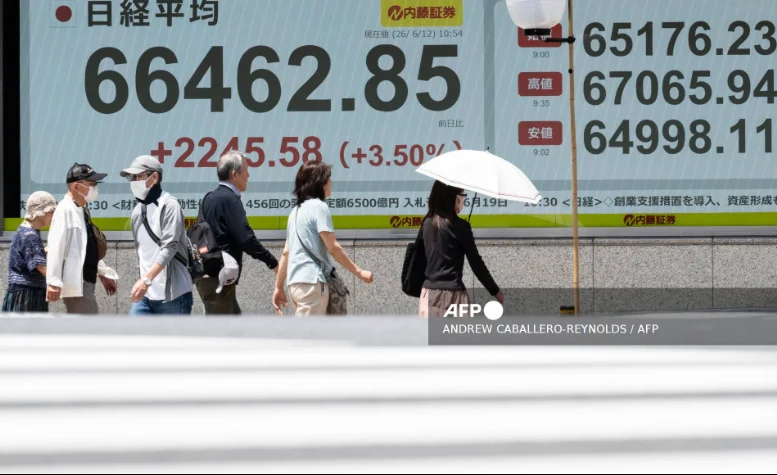
Oil prices, which had fallen last week to pre-war levels, rose on Monday. Equity markets largely finished the day in positive territory. Tokyo’s Nikkei 225 was up 0.2 per cent at 69,468.11, Hong Kong’s Hang Seng Index rose 1.6 per cent to 23,026.68, and Shanghai’s Composite gained 1.2 per cent to 4,073.90. Sydney, Singapore, Wellington, Taipei, Manila, and Bangkok also saw increases. However, Mumbai and Jakarta slipped, while London’s FTSE 100 retreated 0.1 per cent to 10,496.46, and Paris also fell. Frankfurt, conversely, edged up.
Currency markets also saw movement: the Euro/dollar was up at 1.1388 on Friday, Pound/dollar was up at 1.3200, Dollar/yen was up at 161.80 yen from 161.75 yen, and Euro/pound was up at 86.29 pence from 86.28 pence. The New York Dow closed down 0.1 per cent at 51,876.11.
AI Investment Boom Sparks Tech Sector Volatility
Tech firms remained a focal point after leading significant losses last week. South Korean chip makers SK hynix and Samsung extended last week’s selling, weighing on Seoul’s Kospi, which closed down 0.2 per cent at 8,394.65. However, these losses were pared after the South Korean government announced plans to invest nearly $1.2 trillion, equivalent to more than two-thirds of its GDP, in a new chip-building hub and AI data centres over several years.
Samsung and SK are set to make a record investment of more than $500 billion in a new semiconductor fabrication hub in the southwest, officials stated during an event attended by President Lee Jae Myung to unveil the public-private collaboration. The tech sector has been impacted by concerns that valuations have become excessive and questions about when firms will see a return on the trillions of dollars pumped into AI.
The tech rally has propelled Seoul, Tokyo, and Wall Street’s three main indexes to record highs this year, with SK hynix soaring 300 per cent in the first six months of the year. The Bank for International Settlements (BIS), often referred to as the central bank of central banks, issued a warning on Sunday about a possible bust following a prolonged investment boom by companies striving to stay ahead in the AI race.
The BIS noted in its annual report that “Disappointment in returns could trigger a sudden pullback in financing and turn the capex boom into a protracted investment bust, with potential knock-on effects on financial conditions.” It added that “a major equity-market correction could have larger macroeconomic consequences today than in the past.”
Investors are also keenly awaiting the release of US jobs data, which could influence the Federal Reserve’s monetary policy plans. The central bank has adopted a more hawkish stance amid concerns over surging inflation exacerbated by the Iran war. IG market analyst Fabien Yip commented, “Last month, the strong data triggered a four per cent sell-off on the Nasdaq, its worst single-day decline in over a year, as higher-for-longer fears weighed heavily on the AI trade.”
Yip further suggested, “A repeat beat on Thursday could trigger a similar rotation; a miss, by contrast, may dampen hike expectations and lift rates-sensitive equities.”