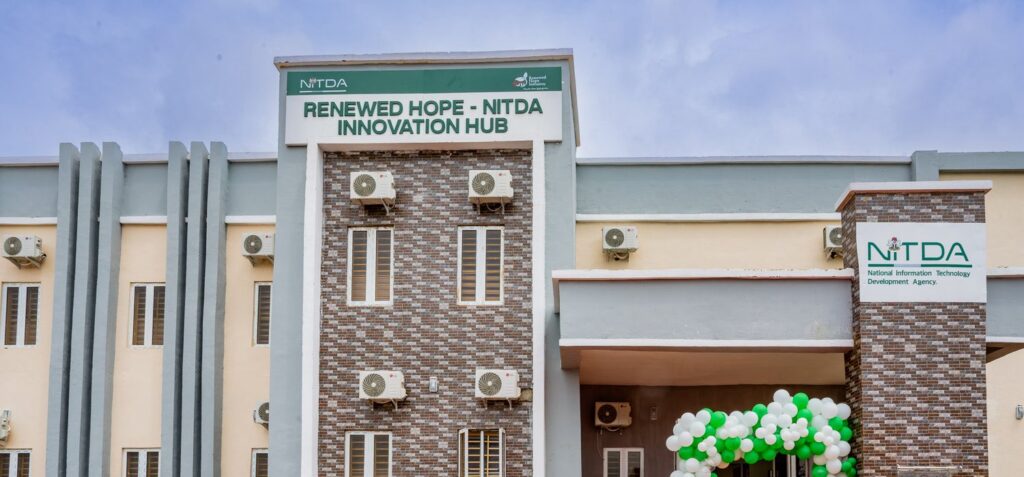
The Federal Government has officially commissioned and handed over the Renewed Hope-NITDA Innovation Hub, a new AI and robotics innovation hub at the Obafemi Awolowo University in Ile-Ife.
The technology hub was unveiled on Monday, June 8, by the Minister of Communications, Innovation and Digital Economy, Dr. Bosun Tijani, during a ceremony at the institution.
Established by the National Information Technology Development Agency (NITDA) in partnership with the Renewed Hope Initiative, the hub is fitted with cutting-edge laboratories dedicated to artificial intelligence, robotics, additive manufacturing, and the Internet of Things.
The facility is designed to close the gap between classroom learning and the practical demands of the global technology industry, giving students and the broader university community access to infrastructure that has historically been out of reach for most Nigerian institutions.
Tijani described the hub as a direct investment in the potential of Nigerian youth rather than simply a collection of equipment and laboratory space.
He challenged Nigerian students to take advantage of the tech innovation hub and step up to lead the nation’s technological evolution.
The minister noted that while the hub will be open to the wider community, its primary purpose is to serve as a launchpad for students seeking to build real-world solutions from what they learn in the classroom.
He urged the OAU community to make full use of the tools available to them to build innovative products that can drive a self-sustaining digital economy and position Nigeria as a serious force in global technology.
The hub comes fully equipped with four specialised laboratories covering artificial intelligence, robotics, additive manufacturing, and the Internet of Things, covering some of the most in-demand areas of the global technology industry.
Additive manufacturing, more commonly known as 3D printing, is increasingly being adopted across sectors including healthcare, aerospace and construction, and its inclusion signals an intent to expose students to industrial applications beyond software.
The IoT and robotics labs also position the hub as a facility capable of supporting hardware-focused innovation, an area where Nigerian startups have struggled due to the high cost of equipment and prototyping.
In February 2026, Nairametrics reported that the Minister of Communications, Innovation and Digital Economy, Dr. Bosun Tijani, said Nigeria’s digital infrastructure is expected to come fully alive by 2027 as the Federal Government accelerates nationwide investments in connectivity.
Tijani disclosed this during an interview with journalists on the sidelines of the “Flagship Nigeria: Electrification + Connectivity Convening” held in Abuja, which was attended by Nairametrics.
According to him, ongoing projects, including 90,000 kilometres of fibre optic cable deployment, the rollout of new communication satellites, and the installation of 3,700 additional rural telecom towers are central to the government’s plan to expand digital access across the country.