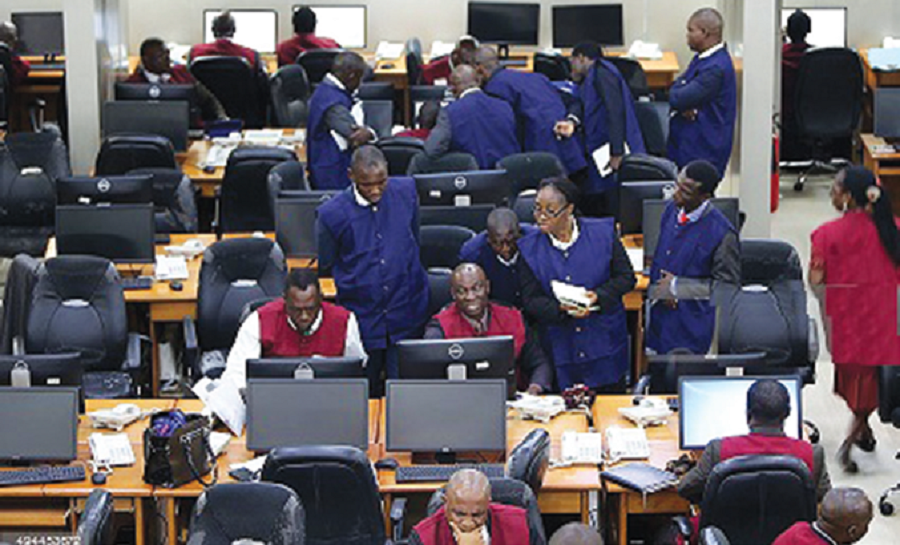
Exactly One Year Ago, a Tax Scare Wiped ₦6.5trn off the NGX. Here's What Happened to People Who Sold
Fears over Nigeria's new capital gains tax drove the NGX to its worst day in 15 years on 11 November 2025. A year on, the All-Share Index is up about 78.5% from that close, and most retail sellers were never in line to pay the tax.
On 11 November 2025, the Nigerian stock market suffered its worst single-day decline in 15 years. The NGX All-Share Index plunged 5.01%, wiping approximately ₦4.6 trillion off the market in a matter of hours. Investors were rushing to sell, and the reason had little to do with company earnings or business performance. An incoming change to capital gains tax had sparked fears that profits from selling shares would soon be taxed at rates as high as 30%, beginning on 1 January 2026.
For investors who had spent the year watching their portfolios grow, the prospect of losing a substantial portion of those gains to tax was enough to trigger a selloff. Selling before the new rules took effect seemed like a reasonable way to protect their profits. Yet one year later, with the All-Share Index having climbed roughly 78.5% from its Black Tuesday close, the decision looks very different. What happened to the investors who sold, and how much of that panic was actually necessary?
What the panic cost
By the end of November 2025, the damage was difficult to ignore. The Nigerian stock market had recorded one of its worst monthly performances, shedding ₦6.54 trillion in market capitalisation. The total value of listed equities fell to ₦91.29 trillion, as weeks of selling erased a significant portion of the gains investors had accumulated earlier in the year.
Foreign investors were among those reacting to the uncertainty surrounding the proposed tax changes. Concerns about how the new rules would affect investment returns added pressure to an already nervous market. Domestic investors were also selling, including retail shareholders who wanted to lock in their profits before the anticipated January implementation date. For many, taking their gains while they could seemed preferable to waiting for clarification.
What made the selloff particularly striking was the market's performance leading up to it. Despite the sharp decline, the All-Share Index was still up about 37% for the year. Nigerian equities had delivered substantial returns throughout 2025, yet uncertainty over a tax that many smaller investors would never have been liable to pay was enough to reverse market sentiment.
The question was whether investors were protecting their gains or giving up the opportunity for further growth.
What the rule actually said
Much of the panic came from the belief that every investor would soon lose up to 30% of their stock market profits to capital gains tax. In practice, 30% is the rate for companies; individuals pay at their personal income tax rates, which top out at 25%. The actual provisions of the Nigeria Tax Act 2025 were considerably more specific, and they offered protections that many investors appeared to overlook.
Under the new rules, gains from selling shares were exempt where the total proceeds from share disposals did not exceed ₦150 million within a consecutive 12-month period, provided the chargeable gains were no more than ₦10 million. These conditions were particularly important for retail investors, whose annual trading activity typically falls well below those thresholds.
The law also provided relief for investors who reinvested qualifying proceeds in shares of Nigerian companies, while allowable capital losses could be used to offset taxable gains under the applicable rules. Importantly, Taiwo Oyedele, chair of the Presidential Committee on Fiscal Policy and Tax Reforms, clarified on 12 November 2025 that the cost base for existing investments would be reset to the higher of the actual acquisition cost or the closing market price on 31 December 2025, so gains built up before the new regime would not become taxable under the new provisions.
For an investor who sold ₦5 million worth of shares at a ₦1 million profit, the feared 30% tax would not have applied under those exemption conditions.
This was the central misunderstanding behind the selloff. Many smaller investors were making decisions based on the highest possible tax rate without considering whether their transactions would attract any tax in the first place. For those comfortably within the exemption thresholds, selling ahead of January offered no capital gains tax advantage under the new rules.
What happened next
The recovery began almost immediately. On 12 November 2025, just one day after Black Tuesday, the Nigerian stock market regained approximately ₦2.6 trillion in market capitalisation. Finance Minister Wale Edun had reassured investors that the government would continue to engage with the capital market over the capital gains tax provisions, and Oyedele's clarification on existing gains followed. Together they helped restore confidence, although the rebound was not enough to prevent November from ending in negative territory.
December brought a more sustained recovery. The market recovered its November losses and finished 2025 with the All-Share Index up 51.19%, closing at 155,613.03 points. It was the NGX's strongest annual performance in 18 years, a remarkable outcome considering how much uncertainty had surrounded the market just weeks earlier.
The momentum continued into 2026. Nigerian equities recorded substantial gains during the first half of the year, supported by renewed investor interest and strong performances across several sectors. The recovery was no longer simply about reversing November's losses. The market was moving well beyond its previous levels.
By 10 November 2026, the latest trading session before this article's publication, the All-Share Index stood at 252,313.16 points, while total market capitalisation had reached approximately ₦163.82 trillion. Compared with the 141,327.30 points recorded on Black Tuesday, the index had risen roughly 78.5%.
For investors who sold during the panic and remained out of the market, that recovery represented a substantial missed opportunity. Those who held a diversified portfolio tracking the broader market would have participated in the rebound, although individual stock returns varied considerably.
The speed of the initial recovery is particularly revealing. Within 24 hours of the crash, a government clarification had already changed market sentiment. Investors who sold in anticipation of further losses faced the possibility of buying back their shares at higher prices almost immediately.
Chart 1: The NGX recovery after Black Tuesday
Chart
Selected verified closes, not a complete daily price series. Source: NGX and contemporary market reports.
The seller vs. the holder
Consider two investors who each had ₦1 million invested in a portfolio tracking the NGX All-Share Index on 26 November 2025, when the index closed at 143,064.57 points. Both had watched the market decline, but they made different decisions.
The first investor sold everything, worried about the incoming capital gains tax, and kept the proceeds in cash. By 10 November 2026, that investor still had ₦1 million, assuming no interest was earned. For an investor whose transactions qualified for the tax exemptions, the capital gains tax avoided by selling was ₦0.
The second investor held on. By 10 November 2026, the All-Share Index had climbed to 252,313.16 points. Their hypothetical ₦1 million investment would now be worth approximately ₦1.76 million, representing a gain of about 76.4%, excluding dividends, fees and tracking differences.
The difference between the two outcomes is roughly ₦763,600. That is the potential return the seller missed while trying to avoid a tax they might never have owed.
Returning to the market would introduce another cost. The seller would have to buy shares at substantially higher prices, potentially acquiring fewer units with the same money, while also paying brokerage and other transaction charges.
Of course, this comparison assumes the seller remained in cash throughout the period. Some investors may have reinvested elsewhere, earned interest or returned to equities before the recovery. Individual stocks also performed differently from the benchmark.
Still, the example illustrates how expensive a precautionary sale can become when the feared policy change has little bearing on an investor's actual tax liability.
Illustrative ASI-tracking investment, 26 Nov 2025 to 10 Nov 2026. Excludes dividends, fees and interest.
Difference: approximately ₦763,631, or 76.4%.
Lessons from the ₦6.5 trillion panic
The November 2025 selloff offers a useful reminder of how quickly uncertainty can influence investment decisions, particularly when a policy announcement appears to threaten returns.
The first lesson is to read the actual rule before reacting to the headline. A proposed 30% capital gains tax sounds alarming, but the thresholds, exemptions and conditions determine whether it applies to you. Understanding those details could be the difference between making an informed decision and selling shares unnecessarily.
The second is to separate policy uncertainty from a change in a company's fundamentals. New regulations can affect valuations, investor confidence and future profitability, so they deserve attention. However, a falling share price does not automatically mean the underlying business has become less valuable. Before selling, consider whether the development materially changes your original investment thesis.
Finally, know your numbers. Historical prices, market movements and individual stock performance provide context that headlines often leave out. On NGN Market, you can examine stock price histories, track how individual equities have performed and compare their movements with the NGX All-Share Index.
The next market scare may involve taxes, interest rates, currency policy or something entirely unexpected. November 2025 showed how costly a rushed decision can become. Taking time to understand the facts will not eliminate investment risk, but it can help you avoid creating unnecessary losses of your own.
Before the next market scare
There will be another policy announcement that unsettles investors. Before you hit sell, ask yourself three questions:
Does this policy actually apply to me? Check the details, thresholds and exemptions.
Has anything fundamentally changed about my investment? Separate temporary market reactions from genuine business risks.
What will selling cost me? Consider taxes, transaction fees and the possibility of buying back at higher prices.
The next headline may be frightening, but you can afford to understand it before acting.
Disclaimer: This article is for informational and educational purposes only and does not constitute financial, investment or tax advice. Past market performance does not guarantee future returns. Consult a qualified professional before making investment decisions.