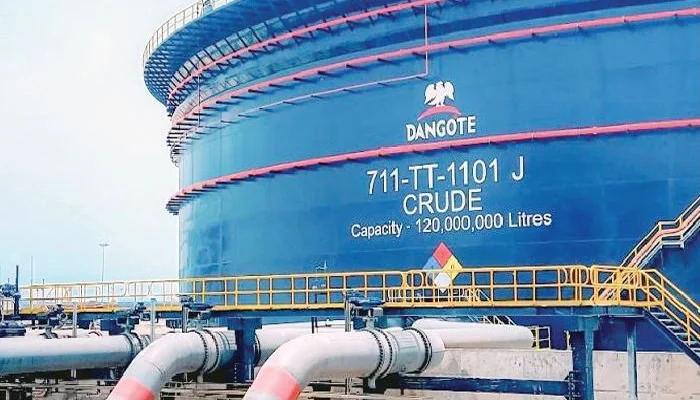
Dangote Petroleum Refinery has vehemently denied allegations that petroleum products refined at its facility are exported to Lomé, Togo, and subsequently re-imported into Nigeria. The refinery's management, in a statement issued on Tuesday, June 23, 2026, described these claims as "baseless," "unsubstantiated," and a "web of falsehoods" not supported by trade realities or commercial logic.
The rebuttal follows recent online reports and comments, including those attributed to Matthew Tracey-Cook of S&P Global Commodity Insights during a webinar, suggesting that Dangote's refined products were finding their way back into Nigeria through the offshore ship-to-ship (STS) trading hub in Lomé.
Refinery's Commercial and Economic Arguments
Dangote Refinery outlined several reasons why the allegations are unfounded. Firstly, facilitating imports that compete directly with its own production would contradict its primary objective of strengthening its position as a leading supplier of petroleum products to the Nigerian market.
Secondly, the economics of such a trade arrangement do not make commercial sense. The estimated logistics cost of transporting products from Dangote Refinery to Lomé and then back into Nigeria is approximately $80–90 per metric ton. These additional costs would significantly erode profit margins, making such transactions commercially unattractive.
The refinery further clarified that it does not offer export discounts of a magnitude that would offset these logistics, storage, financing, and handling expenses, thereby eliminating any viable arbitrage opportunity between export and domestic markets.
Contractual Restrictions and Compliance
Dangote Refinery's sales contracts and tender terms expressly prohibit the resale or re-importation of its products into Nigeria. The company maintains comprehensive records of all product sales, including lifting locations, nominated vessels, counterparties, and destination declarations where applicable.
Any suggestion that the refinery knowingly facilitates re-importation is inconsistent with these contractual restrictions and its established compliance procedures.
Advocacy for Local Refining and Market Context
The company emphasized its consistent advocacy for reducing Nigeria’s dependence on imported petroleum products. It argues that increased imports undermine local refining capacity, place pressure on foreign exchange reserves, and weaken domestic industrial development.
The refinery's response comes amid a broader public debate over fuel prices in Nigeria. Petrol prices have seen sharp increases, climbing from about ₦870 per litre before the recent conflict involving the United States, Israel, and Iran, to nearly ₦1,500 per litre in some parts of the country. It currently sells for around ₦1,340 per litre at many filling stations in Abuja and other major cities.
Despite a ceasefire agreement and a subsequent retreat in global oil prices, with Brent crude trading between $74.95 and $75.07 per barrel over the past 24 hours, domestic petrol prices have not yet fully reflected this decline. Data from the Nigerian Midstream and Downstream Petroleum Regulatory Authority (NMDPRA) showed that average daily imports of Premium Motor Spirit (PMS) increased by 59.5% to 5.9 million litres per day in May 2026, up from 3.7 million litres per day in April. However, domestic refineries remained the dominant suppliers, accounting for nearly 88% of the total petrol supplied across the country in May, underscoring their growing role in Nigeria’s fuel market.