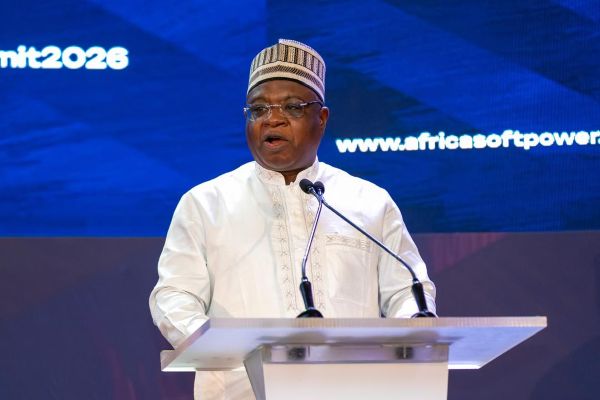
Alhaji Umaru Kwairanga, Chairman of Nigerian Exchange Group, has urged African capital markets and financial institutions to broaden their investment horizons beyond traditional sectors like oil, banking, and manufacturing. He advocates for embracing the continent's rapidly growing creative and innovation economy as a significant asset class.
Kwairanga's remarks were delivered during the Africa Soft Power Summit in Nairobi, a gathering of policymakers, investors, creatives, and business leaders focused on Africa's future. The summit explored how to convert the continent's increasing global cultural influence into sustainable economic value, emphasizing the intersection of creative industries, technology, and capital markets.
He stressed that Africa's burgeoning music, film, and innovation sectors offer substantial investment opportunities that remain largely untapped. Kwairanga stated that these creative industries should be recognized as serious economic sectors capable of generating sustainable returns, rather than being treated as mere cultural footnotes.
While acknowledging the international recognition and financial success some African artists are achieving, Kwairanga pointed out that many creative sectors across the continent lack robust monetization structures, financing systems, and value chains. He questioned the extent to which artists like Tyla, Burna Boy, and Diamond Platnumz are fully capitalizing on branding, copyrights, and concert revenues, and whether industries like Nollywood have value chains that adequately reward all contributors.
Furthermore, Kwairanga raised concerns about replicating the success of companies like Safaricom in Africa's technology hubs without enhanced financing systems and institutional support. He emphasized the need for African exchanges and financial institutions to adapt to evolving economic realities by supporting innovation-driven businesses and facilitating their sustainable scaling.
In parallel, African Export-Import Bank (Afreximbank) announced a Q1 2026 profit of $268.9 million, a notable increase from $215.4 million in Q1 2025. This performance aligns with the bank's ongoing drive to advance Africa's economic development.
The bank's statement indicated that net interest income for the first quarter of 2026 grew by 24% to $510.0 million, up from $411.2 million in the corresponding period of 2025. Afreximbank reported that average loans and advances for Q1 2026 stood at $32 billion, an 8% increase year-on-year, which contributed to the growth in interest income.
The non-performing loan (NPL) ratio remained stable at 2.40% in Q1 2026, consistent with the 2.43% recorded in FY2025 and below the industry average, indicating strong asset quality. Total liabilities increased to $33.9 billion in Q1 2026 from $33.0 billion in FY2025, while shareholders' funds grew to $8.6 billion as of March 31, 2026, from $8.4 billion in FY2025.
Mr. Denys Denya, Afreximbank's Senior Executive Vice President, commented that the bank's resilient performance was driven by disciplined balance sheet management, sound asset quality, and strong capital and liquidity buffers, despite global uncertainties. He highlighted the successful launch of the $10 billion Gulf Crisis Response Programme as an example of Afreximbank's counter-cyclical role in supporting member countries during disruptions.
Afreximbank remains committed to stabilizing trade flows, easing liquidity pressures, and advancing the industrial and economic transformation of Africa and the Caribbean, with Nigeria being a key beneficiary of its initiatives.