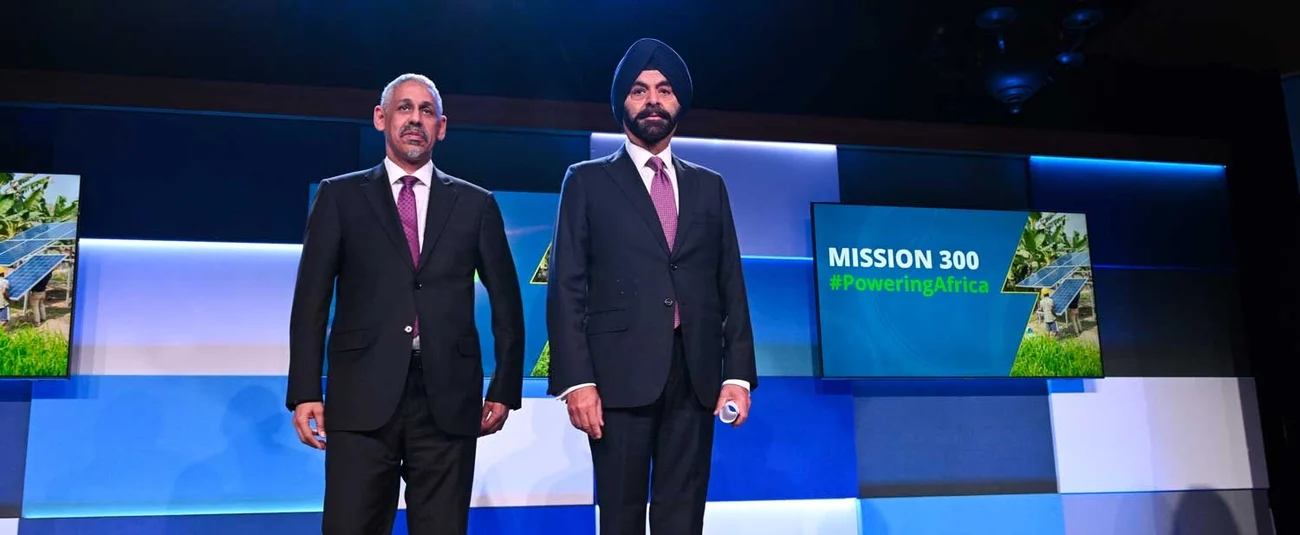
The World Bank and the African Development Bank (AfDB) announced that Mission 300, an initiative aimed at providing electricity to 300 million Africans by 2030, has connected more than 50 million people to power across 40 countries, nearly two years after its launch.
This was disclosed in a joint statement issued by the World Bank and AfDB on Tuesday, as both institutions provided an update on the progress of the continent-wide electrification programme.
Mission 300, a joint programme of the World Bank and AfDB launched in 2024, seeks to expand electricity access to 300 million Africans by 2030 through investments in energy infrastructure, financing, and policy reforms.
The initiative is designed to address Africa’s electricity deficit and accelerate economic development by expanding access to affordable and reliable power.
World Bank President Ajay Banga stated that the initiative is helping countries accelerate electricity access while laying the foundation for long-term expansion of energy infrastructure across the continent.
“Mission 300 is helping countries move faster, connect more people, and build a platform that will last well beyond this effort — one others can use, build on, and scale for years to come,” Banga said.
He stressed that access to electricity goes beyond powering homes and businesses, noting that it plays a critical role in creating jobs, supporting enterprises, improving healthcare delivery, expanding educational opportunities, and driving broader economic development.
AfDB President Sidi Ould Tah said the initiative should serve as a catalyst for broader development outcomes across the continent by improving access to irrigation, healthcare services, and economic opportunities.
“This initiative must become the launchpad for faster electrification to enhance food security on account of affordable irrigation; increase capacity to store medicines for better health outcomes, and spur more inclusive economic and social empowerment,” Tah said.
The latest milestone means Mission 300 has achieved nearly one-fifth of its target of connecting 300 million Africans to electricity by 2030.
If successful, the programme would provide power to more than half of the estimated 565 million Africans who currently lack electricity access. Africa accounts for more than 80 per cent of the world’s population without electricity, with countries such as South Sudan, Burundi, and Chad recording some of the lowest electrification rates globally.
The initiative evaluates energy projects and mobilises financing for qualified investments, with the objective of raising at least $90 billion from public, private, and multilateral sources.
According to the World Bank and AfDB, at least 7.5 million people in Tanzania, 4.6 million people in Ethiopia, and a similar number in Nigeria have already benefited from the programme.
To date, both institutions have committed nearly $15 billion to Mission 300 and secured about $4.5 billion in co-financing. Additional development partners have also pledged more than $7 billion in support of the initiative.
The programme has further encouraged energy-sector reforms across the continent, with 30 African countries already establishing National Energy Compacts—country-led plans aimed at strengthening energy systems and expanding access to affordable electricity.
Additional compacts are expected to be unveiled this week by Burkina Faso, the Central African Republic, Djibouti, Gabon, Rwanda, and Uganda.
In February 2026, Mission 300 disclosed that it plans to provide household energy access to 17.5 million Nigerians as part of its broader electrification strategy.
A month earlier, the African Development Bank approved a $3.9 million two-year project to support Nigeria and 12 other African countries in implementing energy compacts under Mission 300.
Also in January, the World Bank approved $50 million to expand solar-powered agricultural solutions in Nigeria and five other African countries, with the aim of boosting productivity, reducing post-harvest losses, and expanding clean energy access.
In January 2025, former AfDB President Akinwumi Adesina announced that the AfDB and the World Bank Group were jointly committing $40 billion towards the Mission 300 initiative, underscoring the scale of international support behind Africa’s electrification drive.