Namibia's central bank has raised its benchmark interest rate by 25 basis points to 6.75%, marking its first rate increase in three years. This move comes as the bank also revised its 2026 inflation forecast upward, driven by rising global energy costs.
The decision was announced by the Bank of Namibia following its Monetary Policy Committee (MPC) meeting on Wednesday. The apex bank stated that policy tightening was warranted given subdued domestic economic activity and sluggish credit extension.
The Bank of Namibia indicated that the decision reflects growing concerns over both domestic and global inflation risks. The MPC noted rising global and domestic inflationary pressures over the near term, despite other geopolitical developments.
A moderate policy tightening was deemed appropriate due to subdued economic activity and weak credit growth. Domestic economic conditions remained soft during the first four months of the year, with private sector credit extension showing only marginal improvement.
Inflationary pressures have intensified since the bank's previous policy meeting. Annual inflation in Namibia accelerated to 4.1% in May 2026, up from 3.1% in April, despite government measures to cushion consumers from rising global fuel prices through lower fuel levies.
The central bank also raised its inflation outlook for the year, now expecting inflation to average 4.0% in 2026, compared with its earlier forecast of 3.7% issued in April. This revision is attributed to higher energy and food prices.
Inflation has risen across several monitored economies due to energy price shocks and supply chain disruptions. For instance, South Africa's inflation increased from 3.1% in March 2026 to 4.0% in April 2026, contributing to regional price pressures.
International Monetary Fund projections indicate that global inflation could rise from 4.1% in 2025 to 4.4% in 2026 before easing to 3.7% in 2027. Elevated energy and food costs are expected to remain key drivers of inflation over the near term.
Namibia's monetary policy is closely linked to that of neighbouring South Africa, as the Namibian dollar is pegged one-to-one with the South African rand. The South African Reserve Bank raised interest rates last month for the first time in three years, reflecting similar concerns about inflationary pressures.
The Bank of Namibia’s latest move is expected to help preserve the currency peg while containing imported inflation and maintaining financial stability. Central banks across Africa are adjusting monetary policy in response to renewed global inflation risks driven by higher energy prices and geopolitical developments.
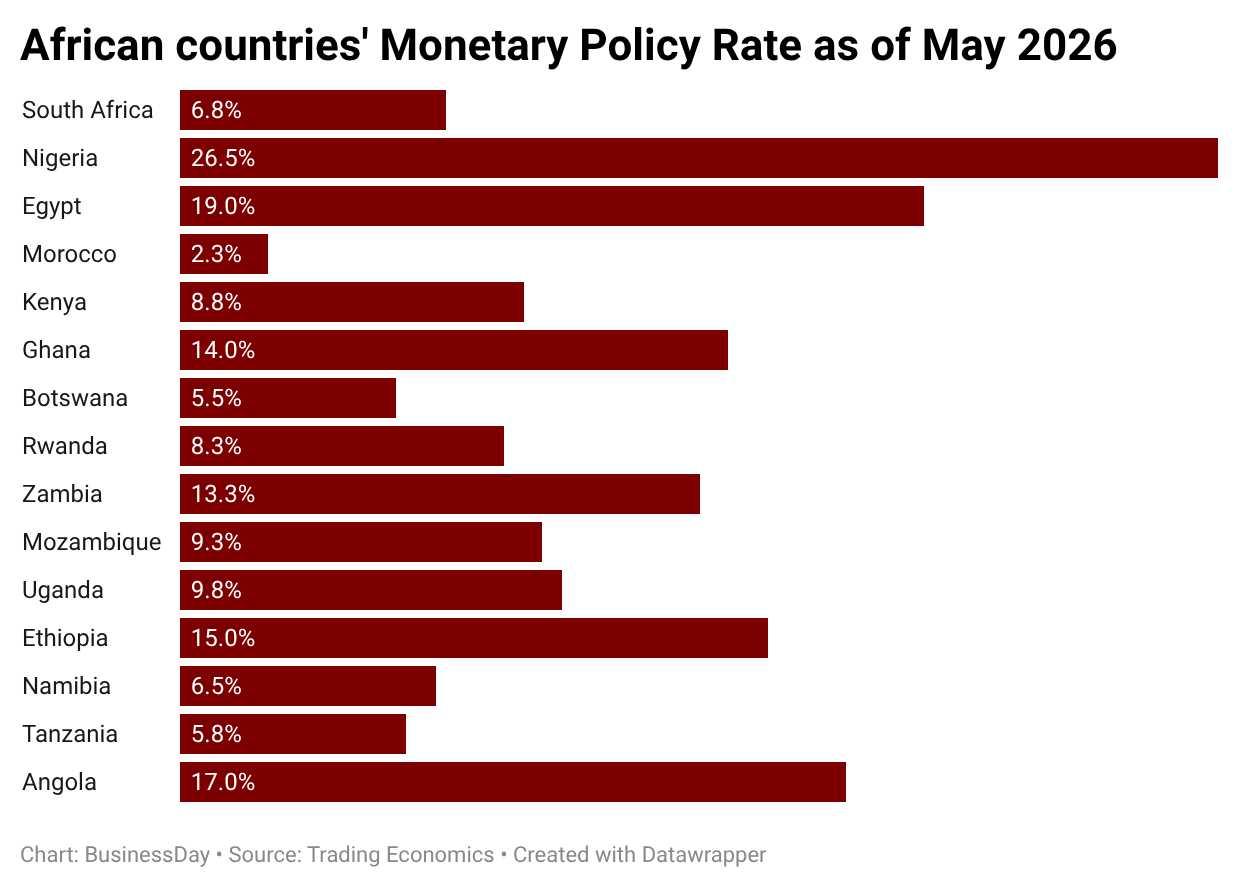
The Central Bank of Nigeria (CBN) maintained its Monetary Policy Rate (MPR) at 26.5% after its 305th MPC meeting in May 2026. Policymakers across the continent continue to balance inflation control with the need to support economic growth amid uncertain global conditions.