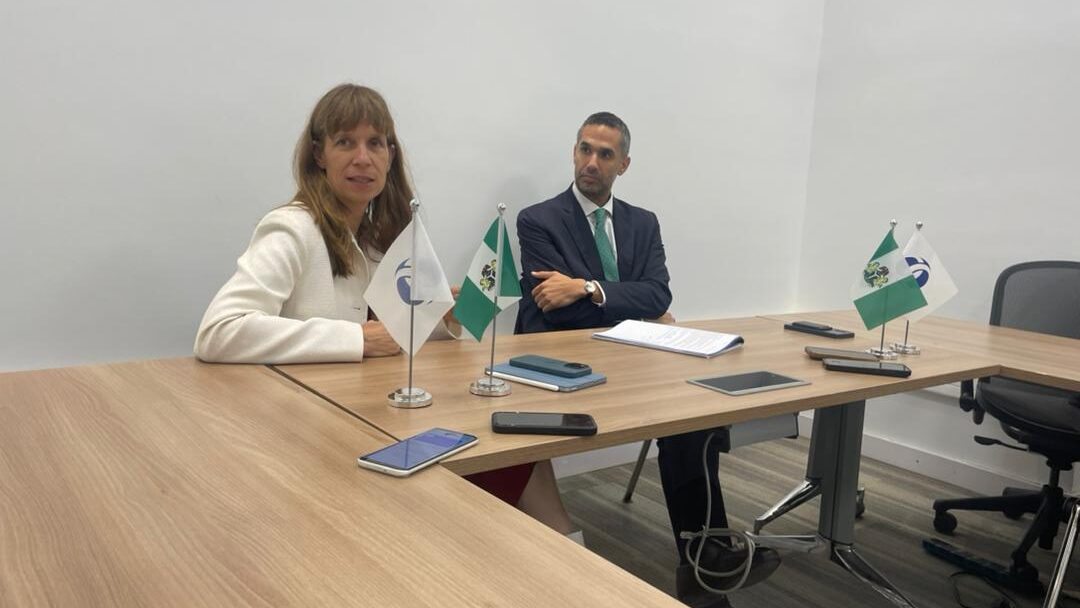
The European Bank for Reconstruction and Development (EBRD) has set an ambitious target to invest at least $1.5 billion in Nigeria over the next three years. This projection was announced during the official opening of the bank’s first Sub-Saharan Africa office in Lagos on Friday, July 4, 2026.
Heike Harmgart, EBRD’s Managing Director for Sub-Saharan Africa, and Hamza Al-Assad, the bank’s Country Director and Head of Nigerian operations, disclosed the investment goal. The move signifies the financial institution’s confidence in Nigeria’s private sector and its investment potential, following the bank’s entry into the country in October 2025.
Ms. Harmgart emphasized a demand-driven investment approach, stating that the bank would finance viable projects as they arise rather than adhering to predetermined allocations. She noted the bank's rapid progress, having already committed about $280 million in Nigeria within its first year, including $180 million in the first half of 2026.
“We’re probably looking at around $300 million this year, but we don’t have a particular ceiling or target as such,” Ms. Harmgart explained, reiterating the $1.5 billion estimate for the next three years.
Focus on Trade Finance and Diversified Sectors
One of EBRD’s initial transactions in Nigeria was a $100 million trade finance facility provided to Access Bank. This facility aims to enhance access to finance for Nigerian importers and exporters, supporting intra-African trade under the African Continental Free Trade Area (AfCFTA).
Ms. Harmgart highlighted trade finance as a key instrument for strengthening continental trade, mentioning similar initiatives being replicated across other African markets. She cited an upcoming trade finance project with Ecobank in Senegal and a recently approved transaction for KCB in Kenya.
Mr. Al-Assad confirmed that the Access Bank transaction was EBRD’s first financial institution partnership in Sub-Saharan Africa. He added that discussions are underway with numerous other Nigerian lenders, focusing initially on trade finance products and senior debt opportunities with Tier-1 and some Tier-2 banks.
Beyond banking, Mr. Al-Assad stated that EBRD plans to diversify investments across various sectors of the Nigerian economy. Key areas include infrastructure (physical, municipal, and energy), the corporate sector, food and agribusiness, real estate, natural resources, mining, manufacturing, and services.
In February, the Minister of Communication, Innovative and Digital Economy, Bosun Tijani, announced that Nigeria secured a $100 million investment from EBRD for Project Bridge, a nationwide digital connectivity initiative. Mr. Al-Assad described Nigeria as a market with exceptional potential, noting that no single development finance institution could meet the country’s investment needs alone.
The bank's global investment model allocates approximately 80 per cent of its financing to private businesses, financial institutions, and investors, with the remaining 20 per cent directed to public sector projects. EBRD has also invested roughly $500 million across its five new African markets (Sub-Saharan Africa) during its first year of operations, which include Kenya, Senegal, Cote d’Ivoire, and Benin Republic.