Nigerian banks are demonstrating significant growth, with four major lenders securing spots among Africa’s 10 fastest-growing banks by Tier 1 capital in The Banker’s 2026 Top 1000 World Banks rankings. This achievement highlights the impact of recent recapitalisation efforts, strategic pan-African expansion, and a stabilising domestic economy on Nigeria’s banking sector.
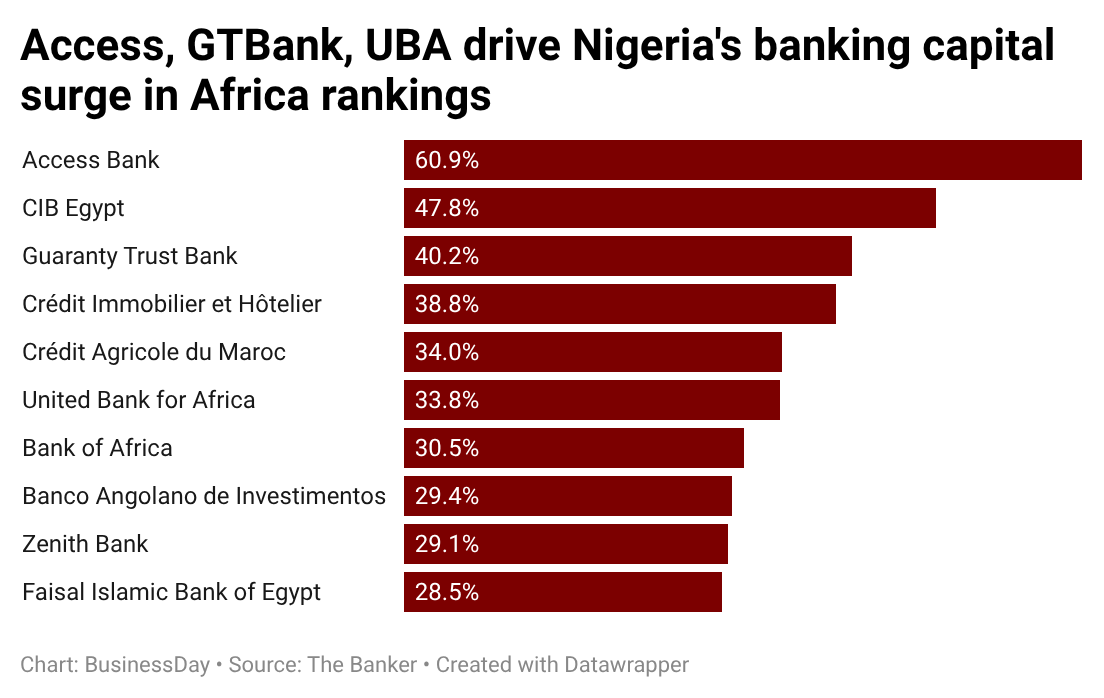
An analysis by BusinessDay of the latest rankings revealed that Access Holdings, Guaranty Trust Bank (GTBank), United Bank for Africa (UBA), and Zenith Bank were key drivers of capital growth in 2025. Access Holdings, Nigeria’s largest banking group by assets, led the continental ranking with a 60.9 percent increase in its Tier 1 capital, reaching $2.46 billion—the highest recorded by any African lender.
Egypt’s Commercial International Bank (CIB) followed with a 47.8 percent rise to $3.91 billion. GTBank secured the third position with a 40.2 percent increase, while UBA placed sixth and Zenith Bank ranked ninth with a 29.1 percent growth. This strong representation underscores Nigeria’s emergence as a rapidly expanding banking market, even as South Africa maintains its position as the continent’s largest banking hub by assets and capital.
The Banker noted that Nigerian banks are advancing in the rankings, leveraging a stabilising economy and the dollar’s weakness. Access Holdings’ exceptional performance was attributed to the final phase of its aggressive acquisition strategy, which included completing the acquisitions of National Bank of Kenya and several Standard Chartered subsidiaries across Africa.
Zenith Bank climbed 55 places globally to 526th, driven by its 29.1 percent increase in Tier 1 capital. However, The Banker indicated that GTBank marginally outperformed Zenith in Nigerian performance rankings, excelling in operational efficiency, asset quality, and financial soundness. Tier 1 capital, primarily composed of common equity and retained earnings, is a crucial measure of a bank’s financial health and resilience under the Basel III framework.
Recapitalisation Fuels Expansion
The impressive performance of Nigerian lenders follows the completion of the country’s banking recapitalisation exercise, which saw banks raise more than N4.65 trillion ($3.24 billion) in fresh capital. This exercise, one of the largest in two decades, aimed to meet the Central Bank of Nigeria’s new minimum capital requirements, which mandate N500 billion ($345 million) for international banks, N200 billion ($138 million) for national banks, and N50 billion ($34.5 million) for regional lenders.
Access became the first lender to surpass the new threshold, raising N351 billion ($242 million) through a rights issue. Roosevelt Ogbonna, Group Managing Director of Access Bank, clarified during the group’s 2024 investor call that the capital raise was primarily for expansion rather than mere regulatory compliance, stating, “The capital was deployed immediately, and its impact is already visible.”
A significant portion of these funds financed the acquisition of Standard Chartered’s subsidiaries in Angola, Sierra Leone, Tanzania, and The Gambia, along with National Bank of Kenya and a majority stake in Mauritius-based AfrAsia Bank. This strategy has strengthened Access’s position as one of Africa’s most geographically diversified banking groups.
This expansion is already reshaping Access Holdings’ earnings profile. Nigeria’s contribution to the group’s pre-tax profit decreased to 37 percent between January and September 2025 from 61 percent two years prior, while African subsidiaries nearly doubled their contribution to 35 percent. The UK and other international businesses accounted for the remaining 28 percent.
Similar trends are observed across other Nigerian lenders. Zenith Bank, having completed a capital raise of over N350 billion ($242 million), aims to generate approximately half of its profits outside Nigeria over the medium term. The bank has expanded into Côte d’Ivoire and is pursuing licenses in Ethiopia and Kenya to diversify its earnings beyond its home market.
GTCO, the parent company of GTBank, also completed its flagship banking subsidiary’s capital raise, securing more than N209 billion ($144 million) in its initial fundraising phase, followed by a N10 billion ($6.9 million) private placement. Similarly, UBA raised N178.3 billion ($123 million) through a rights issue, building on an earlier N239 billion ($165 million) capital injection, pushing its capital base above the regulatory threshold ahead of the deadline.
Analysts view the recapitalisation exercise as a catalyst for both the growth in size and the strategic reorientation of Nigerian banks. Ayokunle Olubunmi, Head of Financial Institutions Ratings at Agusto & Co., noted that Nigerian lenders are intentionally reducing their reliance on the domestic economy. He added that “Operating in countries with stronger sovereign ratings also helps reduce overall risk.”
Mobifoluwa Adesina, Senior Research and Consulting Analyst at Afrinvest West Africa, highlighted that banks are focused on deploying fresh capital efficiently to generate stable and sustainable returns, especially given Nigeria’s volatile market amid ongoing reforms. Expanding across Africa allows lenders to diversify earnings, spread risk, and position themselves for long-term growth.
This strategy has been further supported by the retreat of international lenders like Barclays, HSBC, and Société Générale from Africa over the past decade, creating acquisition opportunities for well-capitalised regional players. Beyond Nigeria, The Banker observed that Africa’s banking industry continues to outperform global peers despite its comparatively smaller size.