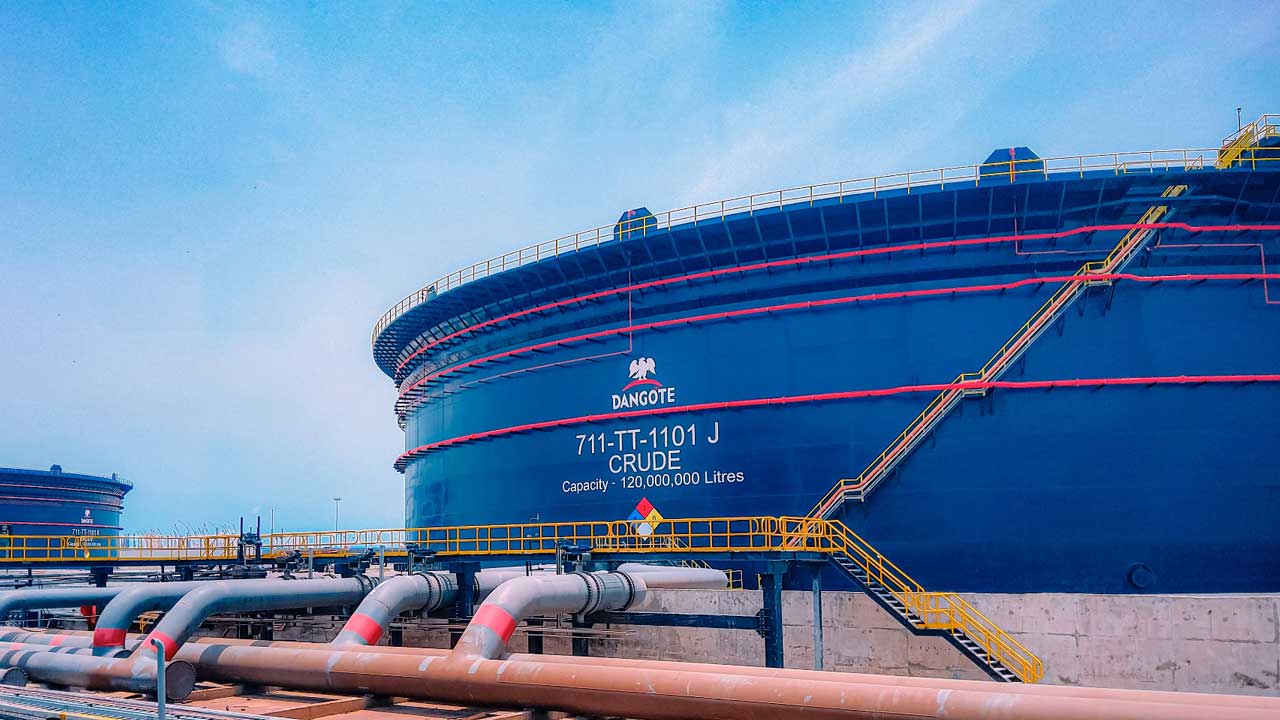
The Dangote Petroleum Refinery has announced it has reached its full designed capacity of 650,000 barrels of crude oil per day (bpd). The company describes this as a historic milestone, making it the first refinery globally to achieve full nameplate capacity in a single train of that scale.
According to a statement issued on Wednesday, February 11, 2026, this milestone was achieved following the optimisation of its Crude Distillation Unit (CDU) and Motor Spirit (MS) production block, further strengthening steady-state operations at Africa’s largest oil refining facility.
The refinery has commenced an intensive 72-hour series of performance test runs in collaboration with its technology licensor, UOP, to validate operational efficiency and confirm that all critical parameters meet global standards.
The Chief Executive Officer of Dangote Refinery, David Bird, said the seamless integration and strong performance of the CDU and MS Block demonstrate the plant’s advanced engineering and operational resilience.
According to Bird, the CDU and MS Block — which include the naphtha hydrotreater, isomerisation unit, and reformer unit — are now operating steadily at the full nameplate capacity of 650,000 bpd. He added that the remaining processing units will begin their respective performance test runs in Phase 2, scheduled to commence next week.
The refinery also disclosed that it supplied between 45–50 million litres of Premium Motor Spirit (PMS) daily during the recent festive period. With the CDU and MS Block fully restored, it says it can now comfortably deliver up to 75 million litres of PMS daily to the domestic market as required.
The 650,000 bpd Dangote Refinery is widely seen as a transformative project for Nigeria’s energy sector. It is designed to significantly reduce, and potentially eliminate, the country’s long-standing reliance on imported refined petroleum products.
Analysts estimate that full operation of the refinery could help Nigeria save up to $10 billion annually in foreign exchange, while generating thousands of direct and indirect jobs, strengthening the naira, and improving regional energy security.
By reducing the need to import over 80% of refined products, the refinery is also expected to stabilise fuel supply, reduce price volatility, and end recurring fuel shortages and long queues.
Beyond fuels, the complex is positioned to boost downstream industrial growth, including petrochemicals and fertiliser production, with broader positive implications for Nigeria’s GDP.
The refinery is located on a 6,180-acre (2,500-hectare) site at the Lekki Free Trade Zone in Lagos and is supplied by a 1,100-kilometre subsea pipeline network.
In October 2025, Aliko Dangote announced plans to expand the refinery’s capacity from 650,000 bpd to 1.4 million bpd. Once completed, the expanded facility would surpass India’s 1.36 million bpd Jamnagar refinery, currently the largest in the world.
The planned expansion will also support additional petrochemical investments, including linear alkylbenzene and base oils production, while increasing annual polypropylene output from one million to 1.5 million metric tonnes.