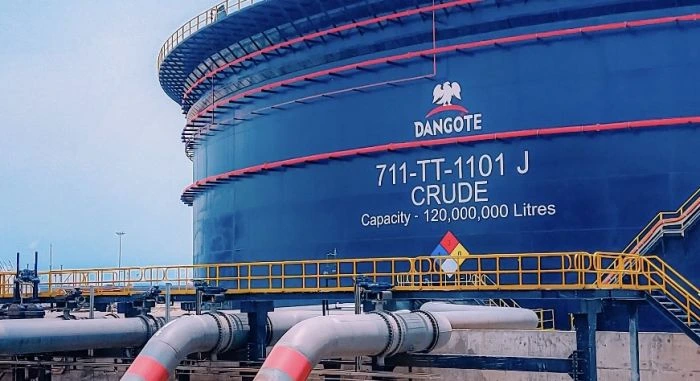
Dangote Petroleum Refinery has recorded its first oil output from its upstream assets and is set to begin pumping marketable crude in the coming weeks. This development marks a significant step in the company's expansion into upstream oil production, aiming to secure supply for its large-scale refinery near Lagos.
The announcement was made by Devakumar Edwin, Vice President of Dangote’s oil and gas division, in an interview on 17 April. Initial testing from the company’s Niger Delta licenses is currently underway. Mr. Edwin stated that a well has been opened and standard testing is in progress, expected to conclude in three to four weeks. Large-scale pumping and new drilling campaigns are planned to follow shortly after.
Early Production and Growth Targets
The company is currently producing around 4,500 barrels per day from the Kalaekule field, located on Oil Mining Lease (OML) 72. This field saw a delayed start-up in December 2025. Production is projected to rise to 15,000 barrels per day within weeks, according to Olajumoke Ajayi, chief executive of West African Exploration and Production (WAEP), Dangote’s upstream joint venture.
Dangote holds an 85% stake in WAEP, which possesses a 45% working interest in OML 71 and 72. The Nigerian National Petroleum Company Limited (NNPC Ltd) holds the remaining stake, with First E&P operating these assets. The oil blocks, situated in shallow waters approximately 22 kilometres from the Bonny terminal, were first discovered in 1966 and acquired from Shell in 2015. Production had previously peaked at 21,000 barrels per day in 1999 before declining in the early 2000s.
Company officials believe this upstream venture could provide a more reliable crude supply for the Dangote refinery, which recently achieved its full nameplate capacity of 650,000 barrels per day. David Bird, CEO of Dangote’s refining business, indicated that the company is also investing in shipping to reduce logistics costs and enhance supply stability. This, combined with in-house crude production, could create a fully integrated system from extraction to refining.
However, Mr. Bird noted that crude supply decisions will remain commercially driven, with joint venture partners seeking maximum value for their output. The refinery will purchase crude if it is economically viable.
Supply Gaps Persist
Despite these upstream efforts, the oil produced from Dangote’s fields will supply only a fraction of the refinery’s total demand. Forecasts suggest that production from OML 71 and 72 could peak at approximately 43,000 barrels of oil equivalent per day by 2036.
The refinery continues to rely heavily on external crude sources. Data from early 2025 indicates that Nigerian grades constituted about 65% of its imports, supplemented by supplies from the United States and Angola. NNPC Ltd is expected to supply up to half of the refinery’s feedstock in the coming months through a combination of naira- and dollar-denominated sales, though historical supply has been inconsistent due to prior contractual obligations.
Nigeria's overall crude oil production has remained below government targets, facing constraints from underinvestment, oil theft, and limited exploration. In March, output stood at approximately 1.38 million barrels per day, falling short of the 2 million bpd goal set for 2026.
The Dangote refinery, recognized as Africa’s largest, has been positioned as a crucial intervention to reduce fuel imports and stabilize domestic supply. However, previous reports have highlighted persistent challenges concerning crude sourcing, pricing disputes, and reliance on imports. The company's move into upstream production represents an attempt to mitigate these constraints by securing a dedicated supply, although analysts suggest it may take years for output to significantly impact its crude demand.
Nevertheless, this development highlights a broader trend in Nigeria’s oil and gas sector, where major domestic players are increasingly adopting integrated models to navigate supply uncertainties and market volatility.