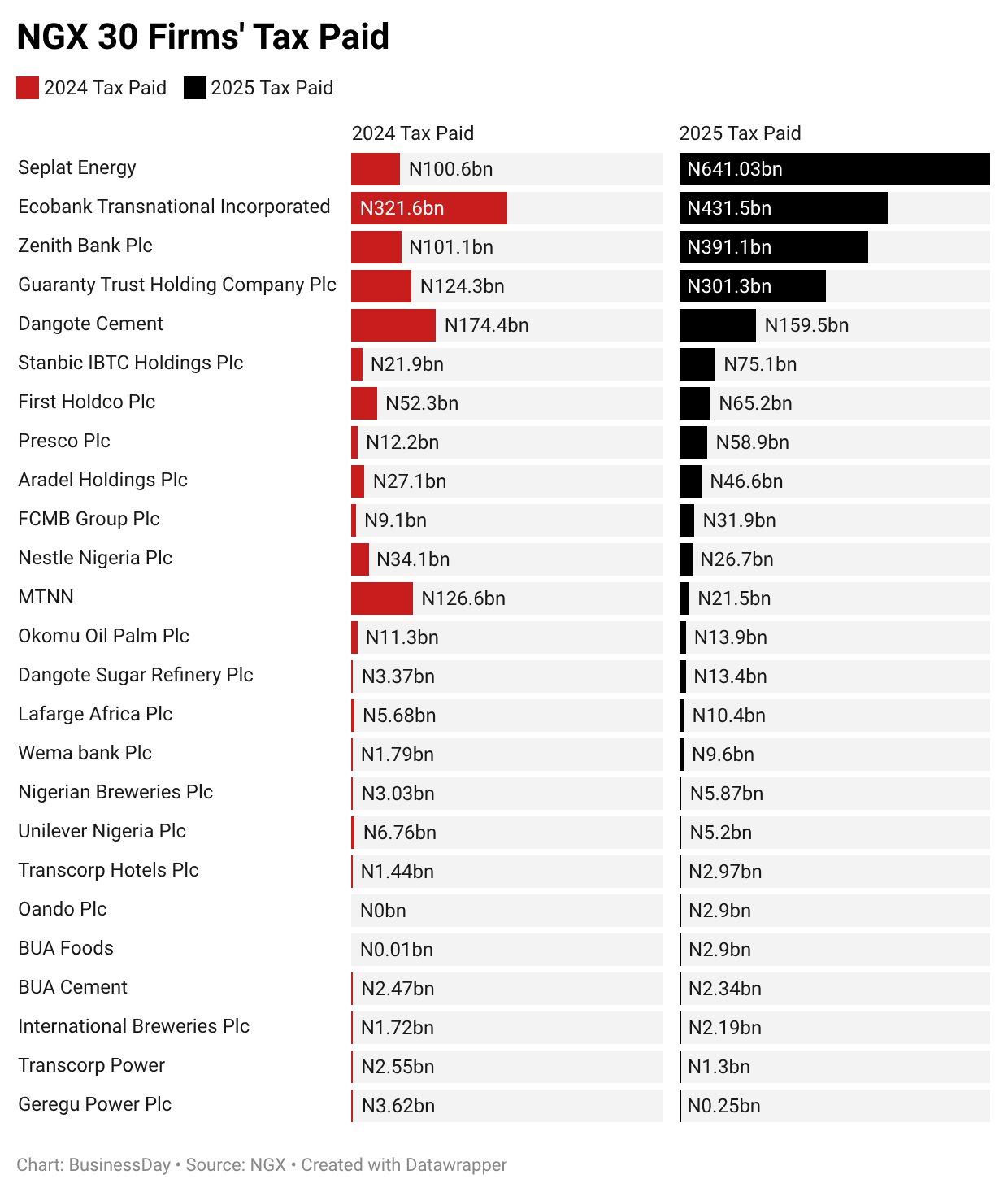
Nigeria's 30 largest companies collectively paid a record N2.32 trillion in income taxes in 2025. This figure marks a substantial 86 percent increase compared to the N1.14 trillion remitted in 2024.
This substantial contribution represents approximately 12.9 percent of the Nigeria Revenue Service's (NRS) total tax revenue for the year. The NRS reported generating N17.8 trillion in tax revenue in 2025, with company income taxes (CIT) making up 51.7 percent, or N9.21 trillion, of this total.
The data indicates that Nigeria's largest companies listed on the NGX were responsible for about 25 percent of the total company income taxes paid in 2025. This underscores a significant reliance on the corporate sector for government tax revenue.
Out of the NGX's 30 largest firms, 25 submitted their full-year financial statements, contributing to the reported tax remittances. Five firms are yet to upload their complete financial statements for the period.
The N2.32 trillion figure specifically reflects taxes that were actually paid, as evidenced by cash flow statements, rather than just tax expenses recorded in income statements. This ensures the data captures real monetary outflows to the government.
Seplat Energy emerges as the highest taxpayer
Seplat Energy, a prominent oil and gas firm on the NGX, led the pack by remitting N641.03 billion in taxes to the federal government in 2025. Under Nigeria's 30 percent corporate income tax framework, Seplat's calculated CIT stood at N226 billion. However, additional charges, including education tax and unrecognised deferred tax assets, increased its effective income tax expense to N513 billion. Despite these significant outflows, the company reported a current tax liability of N307 billion at year-end.
Banks remained top payers in 2025
Commercial banks were major contributors to the tax revenue, reflecting the sector's profitability in 2025. Seven of the eight most capitalised banks on the NGX paid a combined N1.3 trillion in income taxes, a 105 percent increase from the N632 billion paid in 2024.
Ecobank Transnational Incorporated paid the highest among the banks at N431.5 billion. Zenith Bank Plc followed with N391.1 billion, representing a 286 percent surge from N101.1 billion in the prior year. Guaranty Trust Holding Company Plc (GTCO) paid N301.3 billion, up from N124.3 billion in 2024.
Other notable bank contributors include Stanbic IBTC Holdings Plc (N75.1 billion), First Holdco Plc (N65.2 billion), and FCMB Group Plc (N31.9 billion). Wema Bank Plc's tax liability decreased to N9.6 billion from N1.79 billion in the previous year.
The consumer goods sector also made significant contributions, collectively remitting N56.2 billion in 2025, a 14.9 percent increase from N48.9 billion in 2024. Nestle Nigeria paid the highest tax within this sector at N26.7 billion, followed by Nigerian Breweries Plc (N5.8 billion) and Unilever Nigeria (N2.2 billion).
The agriculture sector contributed N72 billion in taxes, primarily from Presco Plc and Okomu Oil Palm Plc. Conversely, the cement sector's combined tax remittances fell to N172.24 billion from N182.55 billion.
MTN Nigeria paid N21.5 billion in taxes in 2025, a significant decrease of 83 percent from N126 billion declared in 2024. The company reported a profit before tax of N1.7 trillion for 2025, a substantial increase from a loss of N550.33 billion in 2024. MTN's CEO, Karl Toriola, noted the company's ongoing advancement in the Road Infrastructure Tax Credit Scheme and secured additional tax credits.
Analysts view on tax concentration
Yvonne Afolabi, a principal consultant at Techpoint Finance Consults, highlighted that the concentration of tax payments among Nigeria's largest firms signifies a structural risk, with a small group of highly capitalized companies bearing a disproportionately large share of the tax burden.
This heavy dependence on a few NGX-listed giants leaves fiscal stability vulnerable to sector-specific downturns, particularly in banking, telecoms, and manufacturing, where these major payers are concentrated. Afolabi noted that while this may indicate improved compliance among top-tier firms, it also points to a shallow and fragmented broader tax base.
A report by PricewaterhouseCoopers (PwC) on corporate taxes explains that listed companies contribute heavily to CIT due to their high turnover, standard 30 percent tax rate, stringent regulatory compliance, and minimum tax obligations even in loss-making years. As formal entities, they are also more accessible for tax authorities to monitor compared to the informal sector.
Potential tax reforms
Under the Nigerian Tax Act, companies currently pay 30 percent of their profits as CIT. However, there is a proposal to reduce this rate to 25 percent. Taiwo Oyedele, former chairman of the Presidential Committee on Fiscal Policy and Tax Reforms and current Minister of Finance and Coordinating Minister of the Economy, indicated that this reduction was initially intended for inclusion in the law but faced resistance from state governors.
A revised approach seeks approval from the governors under the National Economic Council (NEC). Oyedele expressed hope that this matter would be resolved by early 2026, before the new tax law takes effect.