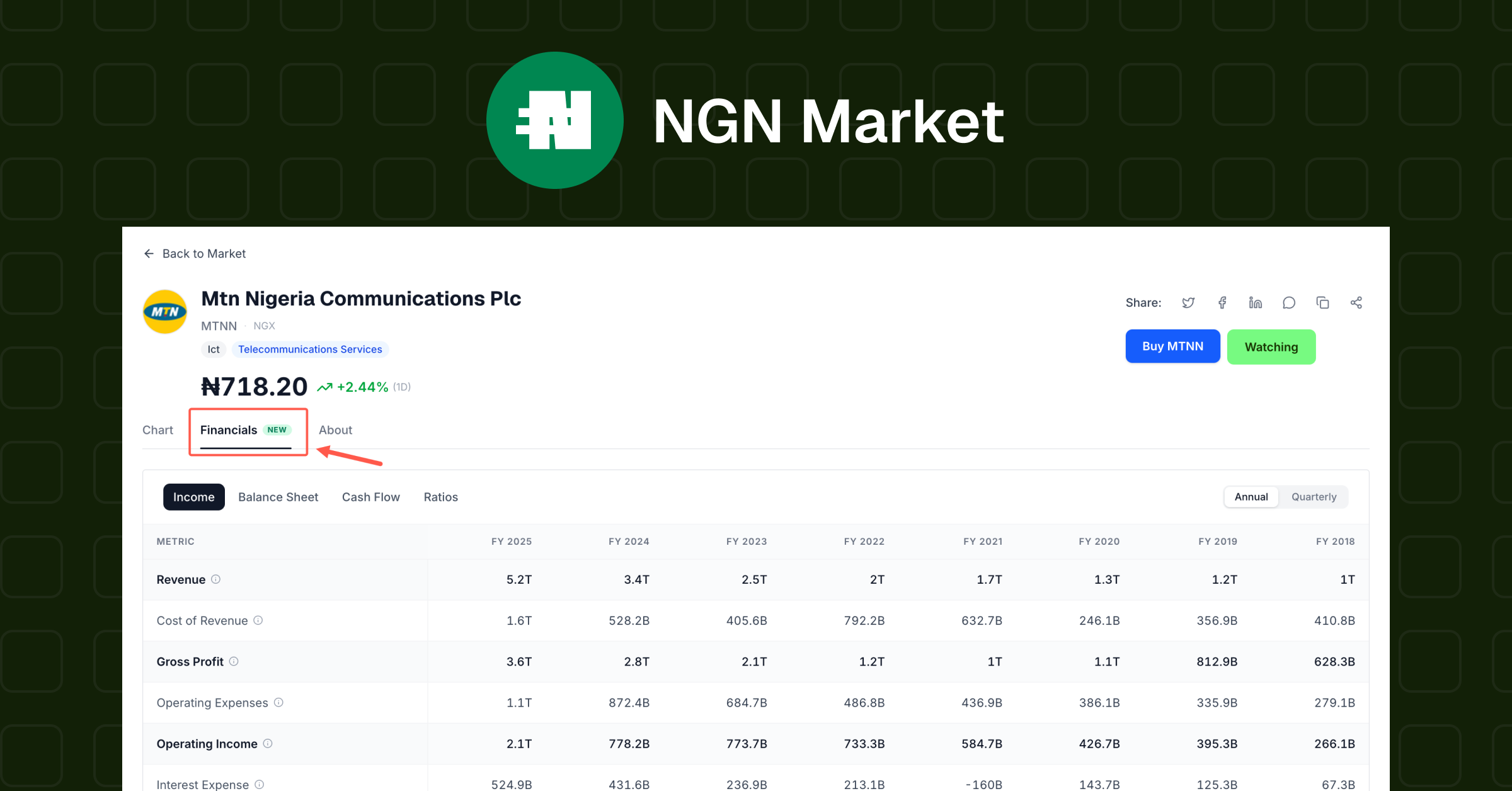
We've added financial statements to NGN Market. Income, Balance Sheet, Cash Flow, and Ratios — all sourced from official company disclosures and built for investors who want to go beyond the price.
It's been about five months since we launched NGN Market to the public and since then it has been the go-to place to check stock prices, track the NGX market, and monitor forex rates for thousands of Nigerians daily.
But knowing a stock's price and knowing whether it's worth buying are two very different things.
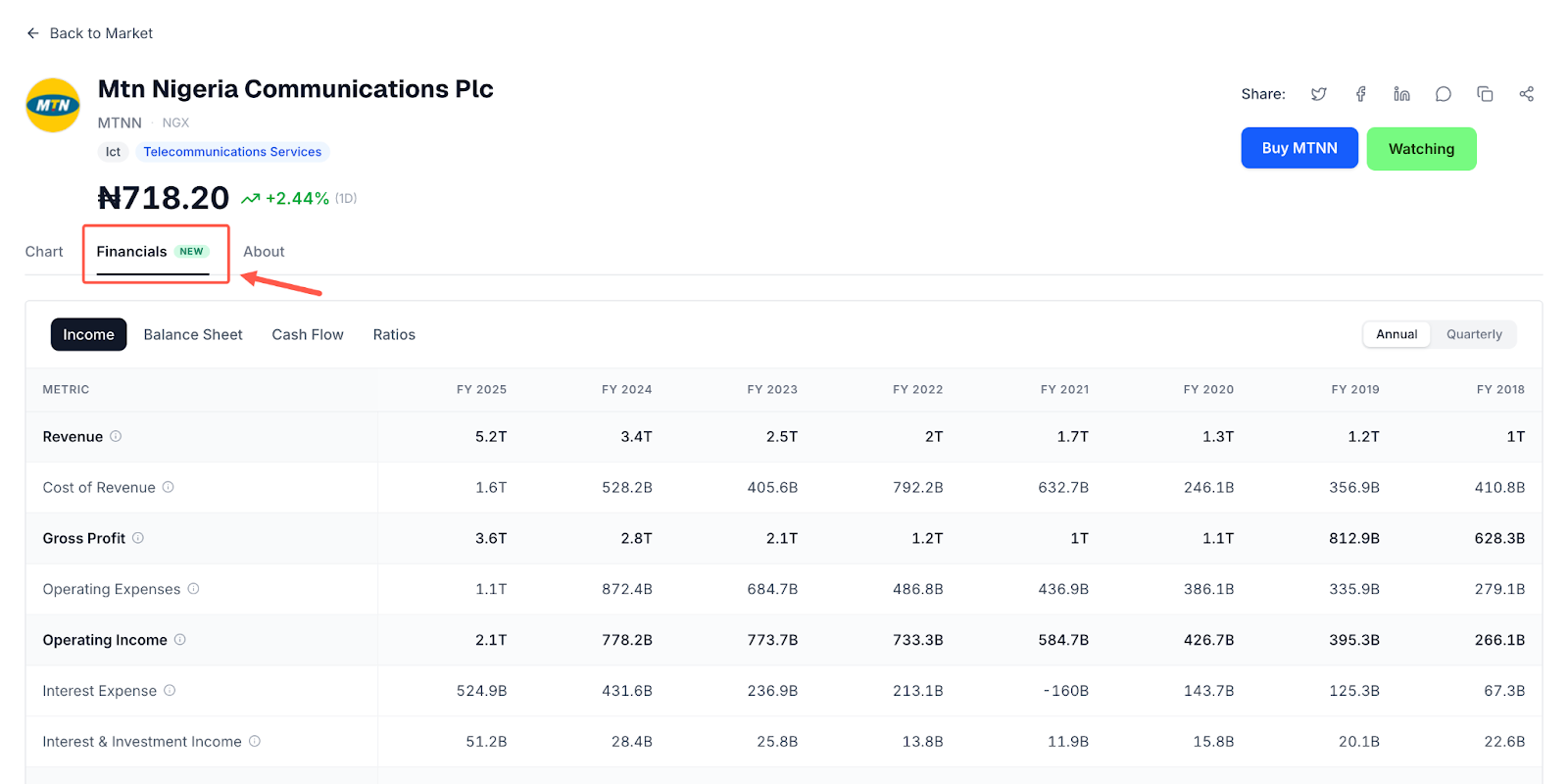
Today, we are happy to share that we've introduced financial statements for companies listed on the Nigerian Exchange. You can now go to any company's page, click the Financials tab, and dig into the numbers that serious investors have always had to hunt for across PDFs, regulatory filings, and third-party databases.
MTN Nigeria financial data on NGN Market
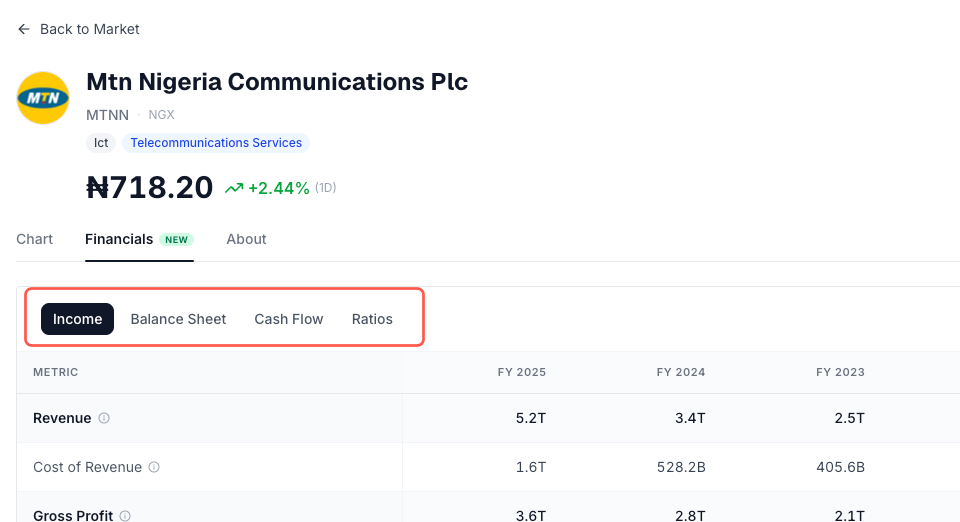
Every company's Financials section is split into four tabs: Income, Balance Sheet, Cash Flow, and Ratios. Each one answers a different question about a company's financial health.
Income, Balance Sheet, Cash Flow and Ratios tabs on NGN Market
Here's a full breakdown of what you're looking at, why it matters, and how to use it.
Income statement
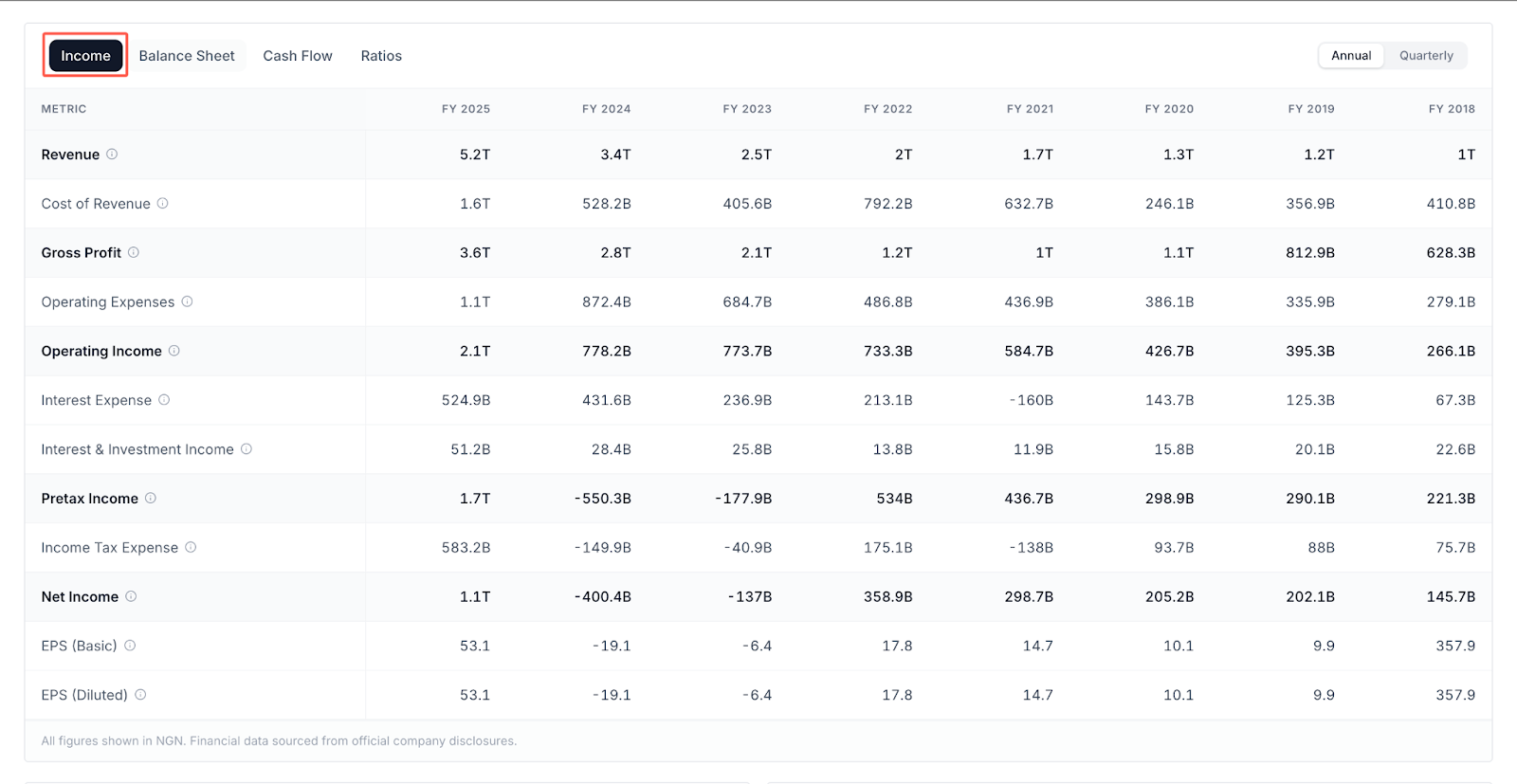
The Income Statement (sometimes called the Profit & Loss statement) tracks everything a company earned and everything it spent over a given period.
Revenue is the starting point. It is the total money the company brought in from its core business. For MTN, this is money earned from data, voice calls, mobile money, and related services. In Q4 2025, MTN posted revenue of ₦1.5 trillion. When you compare that to Q1 2020 (₦329.2 billion), you begin to understand just how dramatically both inflation and growth have reshaped Nigerian business numbers.
Cost of Revenue is what it directly cost to generate that revenue. This includes things like network infrastructure costs, interconnect fees, and direct service delivery expenses. When you subtract this from Revenue, you get Gross Profit.
Gross Profit tells you what's left before the company pays for things like salaries, marketing, and general running costs. MTN's Q4 2025 gross profit was ₦1.3 trillion. You'll notice some quarters have unusually high gross profit figures (sometimes even higher than revenue). This can happen due to accounting reversals or one-off adjustments in cost classification. It's worth digging into the notes whenever you see something that looks off.
Operating Expenses covers the costs of running the business beyond direct service delivery. This covers things like administrative expenses, selling costs, and depreciation. After subtracting this from Gross Profit, you arrive at Operating Income (also called EBIT — Earnings Before Interest and Taxes). This is a cleaner measure of how efficiently the business is being run.
Interest Expense is the cost of borrowing money. For a company like MTN with significant debt on its books, this line item matters a lot. You'll notice some quarters show negative interest expense figures. This typically reflects an accounting reclassification or a reversal, not that the bank is paying them interest.
Pretax Income is Operating Income adjusted for interest and any other non-operating gains or losses. Then the government takes its cut, that's Income Tax Expense. What remains is Net Income (the actual profit or loss the company recorded for the period).
EPS (Earnings Per Share) translates net income into a per-share figure, which makes it easier to compare profitability across companies of different sizes. MTN's EPS (Basic) hit ₦17.3 in Q4 2025, compared to -₦18.6 in Q1 2024, a dramatic swing that reflects the turbulent two-year stretch the company went through with naira devaluation wiping out its reported earnings, before the recovery.
Balance sheet
While the Income Statement covers a period of time, the Balance Sheet is a snapshot that shows the company's financial position at a specific point in time.
It answers the question: if this company closed down today, what would be left?
The Balance Sheet is split into three sections: Assets, Liabilities, and Equity.
Assets are everything the company owns or is owed. This includes:
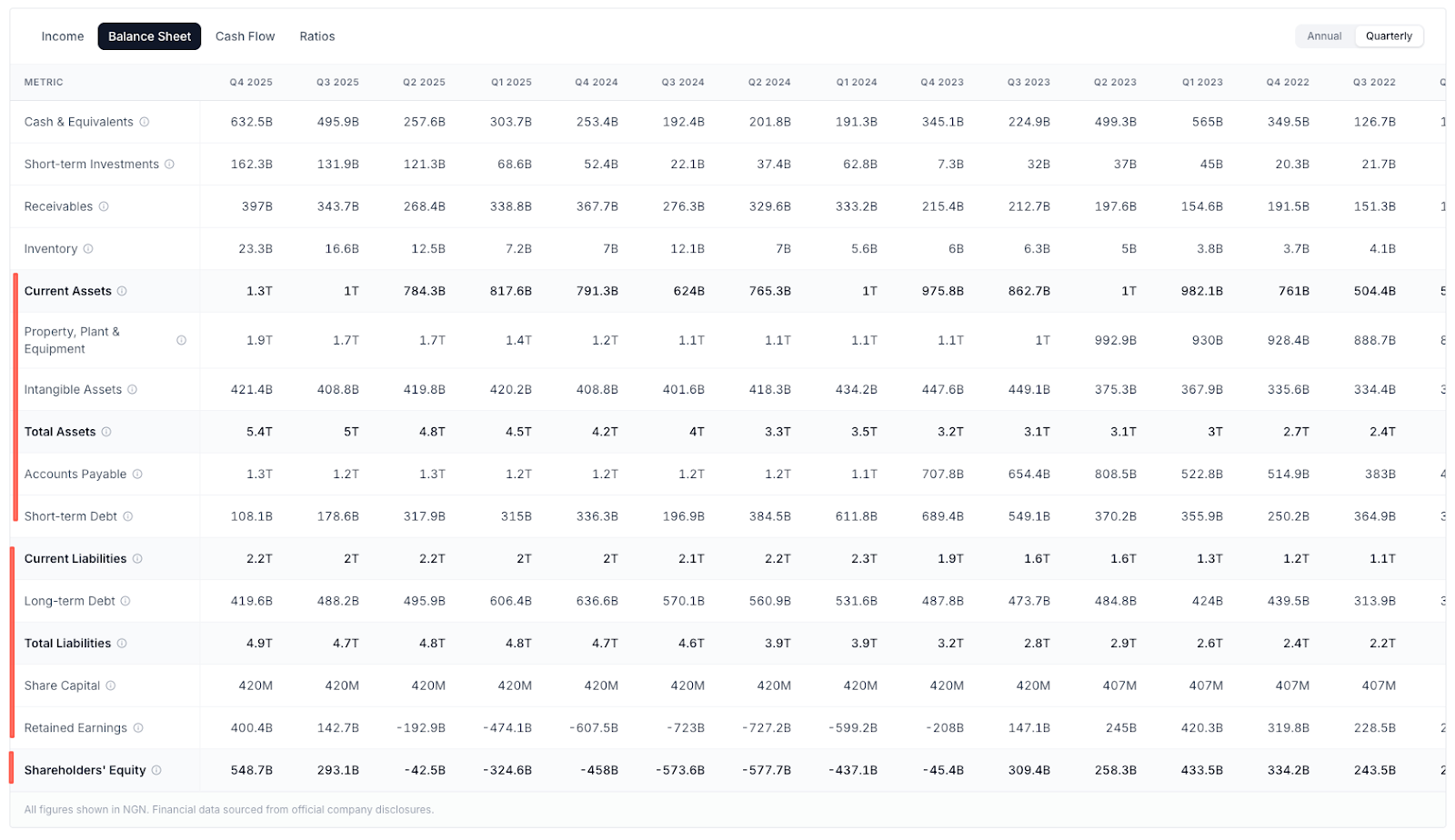
Cash & Equivalents: money the company can access immediately. MTN had ₦632.5 billion in cash at the end of Q4 2025, up sharply from ₦253.4 billion a year earlier.
Short-term Investments: near-cash holdings like Treasury Bills and similar instruments.
Receivables: money owed to the company by customers or other parties that hasn't been collected yet. At ₦397 billion in Q4 2025, this is a significant figure for MTN.
Inventory: for MTN, this is relatively small (SIM cards, handsets, accessories), reflected in the modest ₦23.3 billion figure.
Current Assets: the sum of all assets expected to be converted to cash within 12 months.
Property, Plant & Equipment (PP&E): the physical infrastructure the company owns: cell towers, equipment, buildings. MTN's PP&E of ₦1.9 trillion reflects years of heavy network investment.
Intangible Assets: things like licenses (spectrum licenses, in MTN's case), brand value, and goodwill from acquisitions.
Total Assets: everything combined. MTN's total assets reached ₦5.4 trillion in Q4 2025.
Liabilities are what the company owes:
Accounts Payable: money the company owes to its own suppliers and vendors.
Short-term Debt: borrowings due within the next 12 months.
Current Liabilities: all obligations due within 12 months combined.
Long-term Debt: borrowings with a repayment horizon beyond a year.
Total Liabilities: everything owed combined. MTN's total liabilities at Q4 2025 were ₦4.9 trillion.
Equity is what's left after subtracting liabilities from assets (the net worth of the business that theoretically belongs to shareholders). It includes Share Capital (the nominal value of all shares issued) and Retained Earnings (accumulated profits the company hasn't paid out as dividends).
MTN's retained earnings were deeply negative throughout 2024, reaching as low as -₦607.5 billion because the naira devaluations in 2023 and 2024 created massive foreign exchange losses on the company's foreign-currency borrowings, which had to flow through the income statement.
MTN Nigeria shareholders equity on NGN Market
By Q4 2025, retained earnings had recovered to ₦400.4 billion. This is one of the most important stories the Balance Sheet tells that the stock price alone would never explain.
Cash flow statement
A company can report profits and still run out of cash. The Cash Flow Statement is the antidote to that illusion, tracking the actual movement of money in and out of the business, regardless of accounting entries.
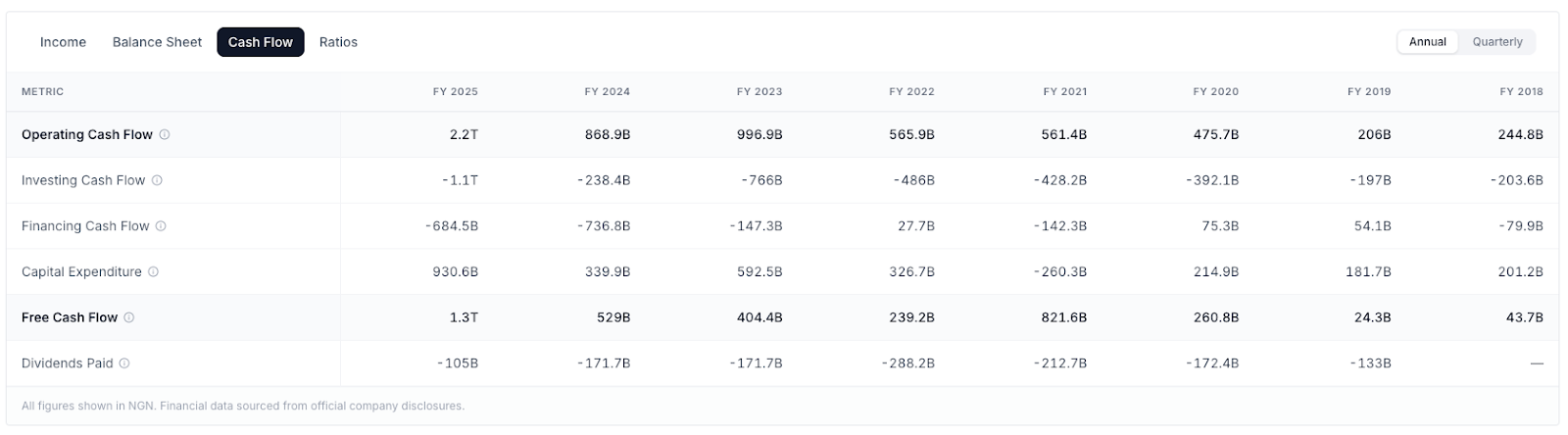
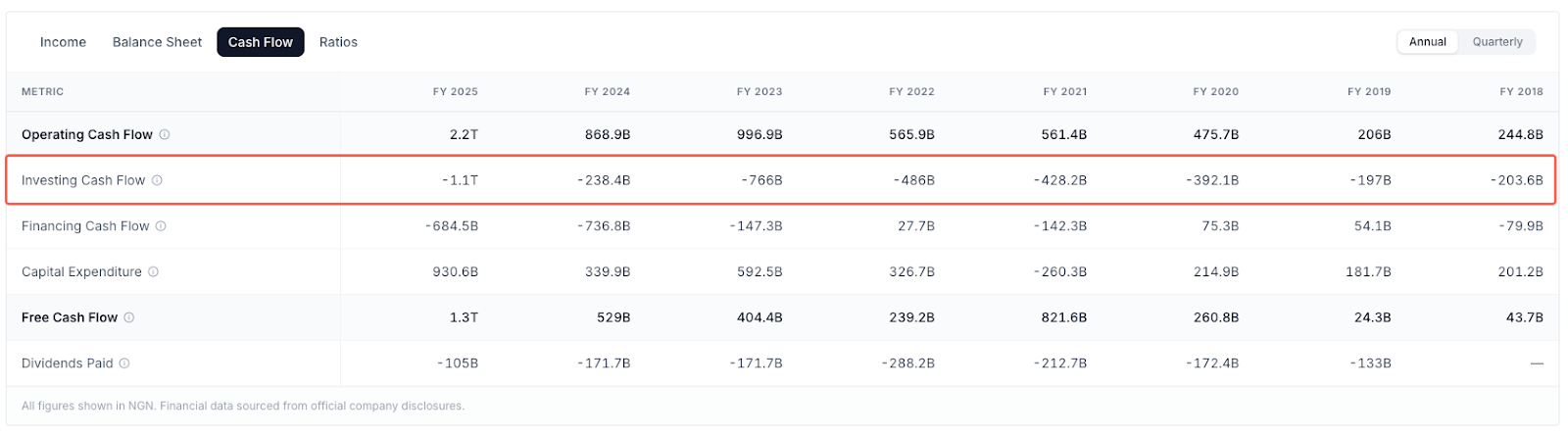
Operating Cash Flow measures cash generated from the company's day-to-day business activities. This is arguably the most important line on the cash flow statement. It strips away non-cash accounting items like depreciation and gives you a raw picture of whether the business actually generates cash. MTN generated ₦1.6 trillion in operating cash flow in Q3 2025 (a strong number by any measure).
Investing Cash Flow captures money spent on (or received from) investments, primarily capital expenditure on infrastructure, but also acquisitions or asset sales. MTN's investing cash flow is consistently negative because the company is constantly spending on network expansion. That's not a red flag; it's the nature of a capital-intensive business.
MTN Nigeria investing cash flow on NGN Market
Financing Cash Flow records the movement of cash between the company and its lenders or shareholders, including borrowing and repaying loans, issuing new shares, and paying dividends.
Capital Expenditure (CapEx), shown separately, is the money spent on physical assets like towers, equipment, and infrastructure. It's one of the biggest expenses for telecoms.
Free Cash Flow is perhaps the most widely watched derived metric in financial analysis. It's Operating Cash Flow minus Capital Expenditure. It tells you how much cash the company generated after investing in maintaining and growing its infrastructure. Positive free cash flow is a sign of financial strength, as the company is producing more cash than it needs to sustain itself.
Dividends Paid shows what was returned directly to shareholders. For income-focused investors on the NGX, this is often one of the first things they look at.
Ratios
This is the benchmarks that put it all in context.
Raw numbers are useful, but ratios make them meaningful. The Ratios tab takes the numbers from the other three statements and turns them into percentages and comparisons that let you evaluate performance across time and across companies.
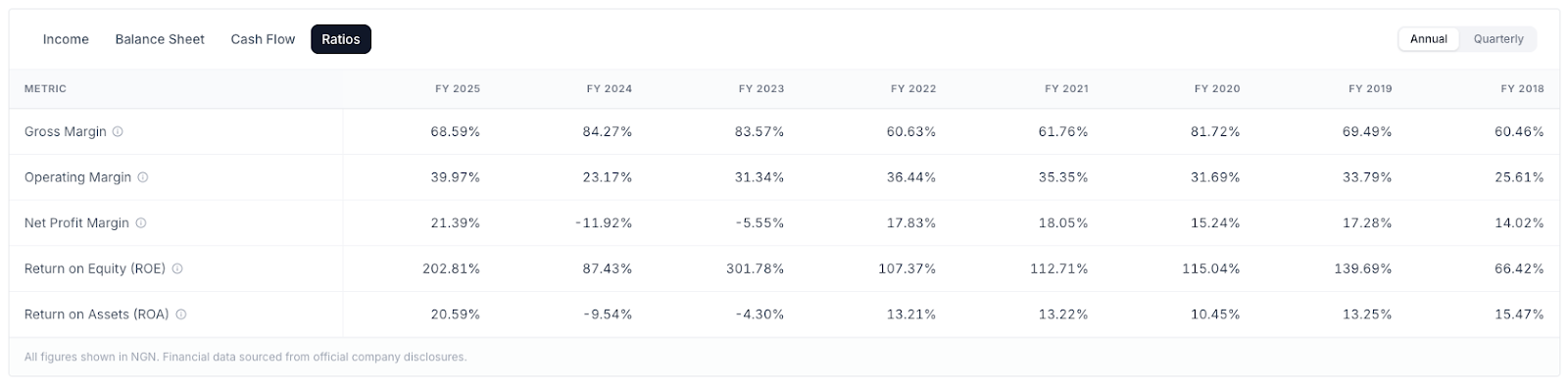
Gross Margin (Gross Profit ÷ Revenue) tells you what percentage of revenue survives after the direct costs of delivering the product or service. A telecom business like MTN typically runs high gross margins because a lot of its costs are fixed infrastructure that it spreads across a massive subscriber base. MTN's gross margin in Q4 2025 was 89.24%, which is exceptionally high, partly reflecting the post-devaluation period, during which naira revenues soared while some cost structures lagged.
Operating Margin (Operating Income ÷ Revenue) is a cleaner measure of profitability. It accounts for the full cost of running the business. MTN's operating margin was 43.33% in Q4 2025. This is the number that shows how efficient the business is at converting revenue into operating profit.
Net Profit Margin (Net Income ÷ Revenue) is the bottom line expressed as a percentage. It reflects everything, including interest costs, taxes, and one-off items. You'll notice MTN's net profit margin turned sharply negative in 2024 (-52.15% in Q1 2024). That wasn't a business collapse, but the accounting impact of forex losses flowing through the income statement. By Q4 2025, it had recovered to 24.64%.
Return on Equity (ROE) measures how effectively the company generates profit from shareholders' equity. It's calculated as Net Income ÷ Shareholders' Equity. You'll see some extreme ROE numbers in MTN's history, like 626% or -662%, because when shareholders' equity is close to zero (as it was during MTN's negative equity phase in 2023–2024), even a small net income or loss produces extreme ratios. Treat the outliers as signals to investigate the balance sheet rather than face-value performance metrics.
Return on Assets (ROA) measures how efficiently the company uses its total asset base to generate profit. Unlike ROE, it doesn't fluctuate wildly with leverage, making it a more stable measure of operational efficiency.
Annual vs. quarterly: How to filter the data
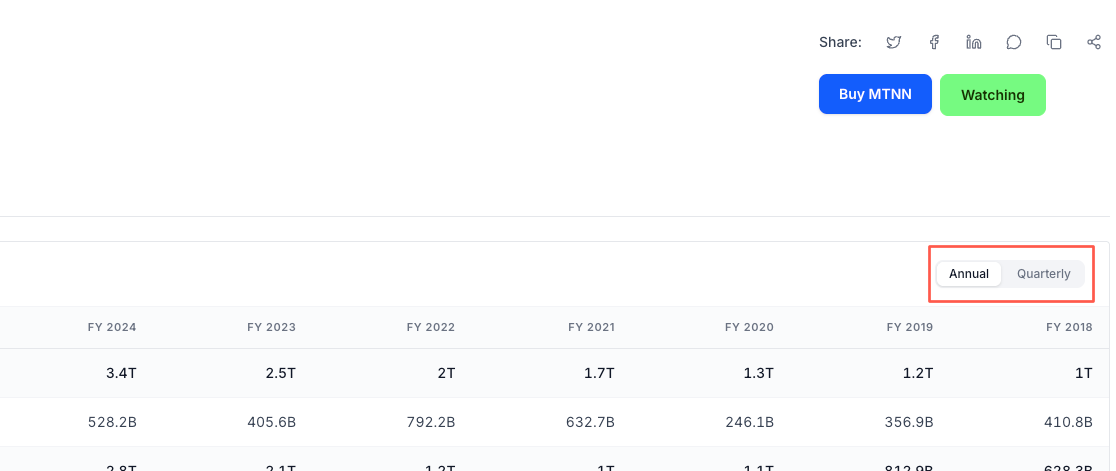
At the top of the financials section, you can switch between Annual and Quarterly views. Each has its place.
Annual and quarterly filter for financial data on NGN Market
Quarterly data is ideal for seeing how a company is trending right now. Are revenues growing each quarter? Is the margin expanding or compressing? Are operating costs being managed? For something like tracking MTN's recovery from the 2024 forex losses, the quarterly view makes the story clear in a way that annual averages would blur.
Annual data is better for long-term analysis, comparing full-year profitability over multiple years, evaluating performance cycles, or assessing whether a company's fundamental trajectory is upward. It also smooths out the seasonal noise that can distort individual quarters.
The Ratios tab shows both views, which is particularly useful as you can check if a strong quarterly margin is a one-off or part of a longer pattern.
Why this matters for Nigerian investors
For a long time, accessing this kind of structured financial data for NGX-listed companies required either a Bloomberg terminal, a local brokerage research subscription, or hours spent manually pulling numbers from PDF annual reports filed with the SEC.
NGN Market has built this, so you don't have to do any of that. The data is sourced from official company disclosures and displayed in a format that lets you actually use it, whether you're comparing two banks, tracking a company's debt levels over time, or trying to understand why a stock has been moving the way it has.
There's more coming. This is the foundation!
For now, the full financial data is accessible to registered users. Creating an account is free. If you've been making investment decisions on price charts alone, the numbers behind the business are now one click away.