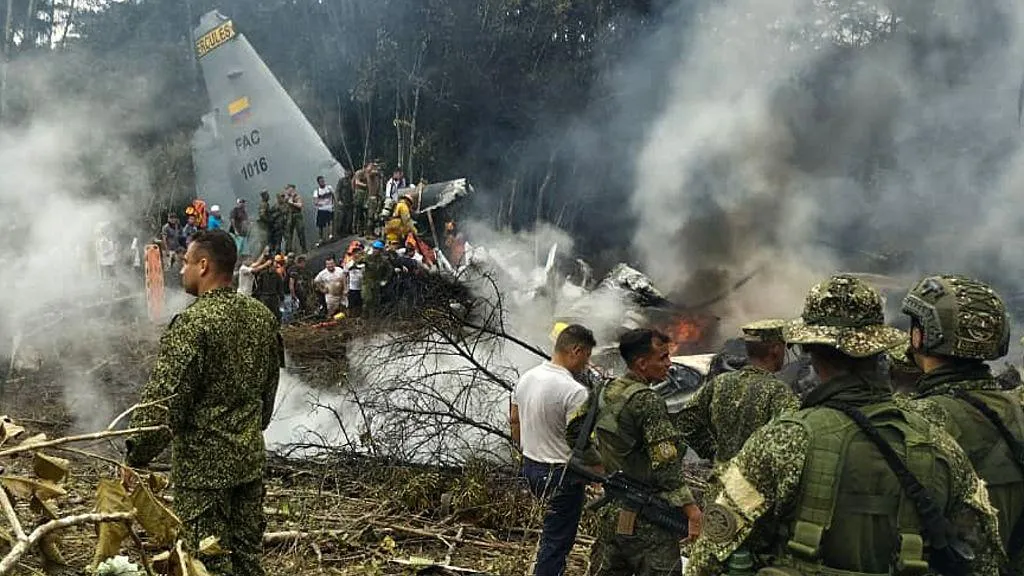
Colombia’s Air Force has confirmed that a transport aircraft crash near Puerto Leguízamo has killed at least 66 military personnel and crew. The disclosure was reported by Reuters, citing military sources and official statements.
The aircraft, a Lockheed Martin C-130 Hercules, was carrying over 120 occupants, including soldiers, air force crew, and police officers, when it crashed shortly after takeoff near Colombia’s southern border with Peru.
Colombia’s Defence Minister, Pedro Sánchez, described the incident as a tragic accident that occurred during a critical phase of flight. Air Force commander Carlos Fernando Silva Rueda also confirmed the number of personnel onboard and the scale of the casualties.
Authorities added that a fire broke out onboard the aircraft, triggering ammunition explosions that worsened the impact, while emergency responders continued rescue operations at the crash site.
The latest crash adds to a growing list of military aviation accidents in the region involving similar aircraft types. In February, a Bolivian Air Force Lockheed Martin C-130 Hercules crashed in El Alto while transporting banknotes, resulting in at least 20 deaths.
The Bolivian aircraft reportedly skidded off the runway after arriving from Santa Cruz. It collided with nearby vehicles, leading to multiple casualties on the ground and onboard. Bolivia’s defence ministry later confirmed the plane was carrying cash for the Central Bank at the time of the crash.
Despite having fewer occupants than the Colombian aircraft, the Bolivian incident raised similar safety concerns around the operation of ageing military transport fleets.
Recent global aviation data shows continued safety gains, though fatal incidents still occur—especially during takeoff and landing. According to the International Air Transport Association (IATA), accident rates edged lower in 2025. The industry recorded 51 accidents across 38.7 million flights in 2025, down from 54 in 2024, with the overall accident rate improving to 1.32 per million flights from 1.42. However, fatal accidents rose slightly to eight, while total onboard fatalities jumped to 394 from 244 the previous year.
Common accident types include tail strikes, landing gear failures, runway excursions, and ground damage—often during critical phases like takeoff. Regionally, safety performance remains uneven. Africa still records the highest accident rate despite improvements, while Asia-Pacific and Europe saw declines, with Europe reporting zero fatalities.
North America recorded a slight increase, Latin America and the Caribbean improved marginally, and the Middle East, North Africa, and North Asia maintained low incident levels.
Despite the rise in fatalities, IATA maintains that aviation remains the safest form of long-distance travel, supported by sustained improvements in global safety standards.